Table Settings
YOU THE DESIGNER
Developed by
Jayne Decker, Hall County Extension Educator Julie A Albrecht, Extension Food Specialist
Boone-Nance Revision — Sonya Glup, B-N-M Extension Assistant
Do you know you can be a designer each time you set the table? A designer chooses and arranges things according to a plan for beauty and order. Anyone can sling dishes on the table so it looks like disaster struck. Or the table can be attractively set with everything neatly in place. A neat, clean and attractive table setting makes any meal more enjoyable. Can you set such a table? Let’s learn how.
Actually, there is more than one way to set a table. The usual way to set a table is to put all the dishes, flatware, and food on the table before anyone sits down. When there is company or for a special meal, part of the food may be left in the kitchen and served later. The way to set your table depends upon the way the meal is to be served. Be creative & have fun!
Table appointments include any item used to set a table. Tablecloth, placemats, dinnerware, glassware, flatware, serving dishes, and the center piece are table appointments. Choose table appointments to fit the occasion. Paper plates, plasticware, and paper napkins may be used for a picnic but they would not be appropriate for a formal dinner.
The Table Cover
The table covering is the background for the food and table appointments placed on it. It protects the table and makes for less noise. Placemats or tablecloths may be used. Some-times the table is left bare. Be sure that the covering or table is clean.
Choose a cover that is appropriate for the occasion and the other table appointments. You may match or blend cloths and textures in the dishes or use something quite different for contrast.
Place Setting
Allow at least 20 inches for each person’s dishes. This is called a “cover” and each cover is set exactly the same. A cover contains only the dinnerware and flatware for the meal served.
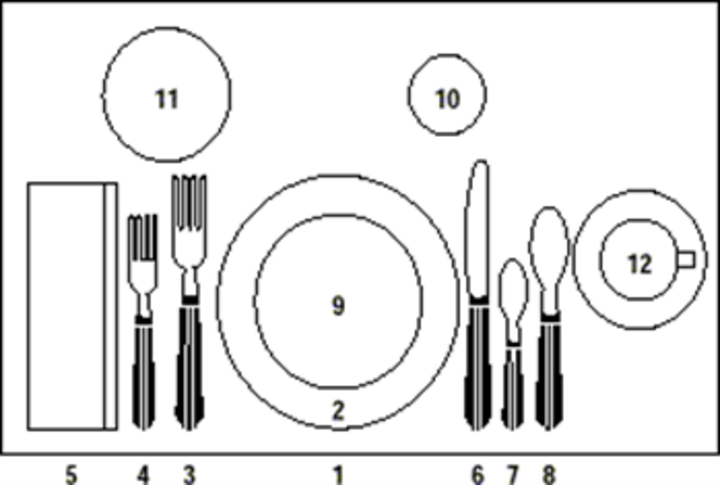
- Put the plate, china, pottery, paper, glass, etc. (1, 2, 9) in the center of the cover about 1 inch from the edge of the table.
- Place the knives and spoons (6, 7, 8) on the right side, the forks (3, 4) on the left about 1 inch from the edge of the table. Turn the cutting edge of the knife towards the plate. If there is more than one piece in each cover, such as one dinner fork and a salad fork or one teaspoon and a soup spoon, determine which one will be used first and place it outside the other one.
- The napkins (5) are usually folded oblong and placed next to the forks. The fold of the oblong should be to the left so it opens like a book. Decorative and creative folds are encouraged. Placement of napkin may vary.
- The beverage glass (10) is placed about 1 inch above the tip of the knife.
- If coffee or tea (12) is served, the cup is placed on the saucer and set to the right of the spoon 1 inch from the edge of the table. Have the handle pointing to the right.
- Salad, bread and/or dessert plate or bowl (11) may be placed left of the forks and napkin or at the tip of the fork.
Serving Pieces
- Place the main dish in front of the family head. If it is hot, it will need a table protector or trivet underneath it.
- Foods that are used together should be placed together, such as potatoes and gravy, bread and butter.
- Serving spoons should be placed on the table beside the food bowls rather than in them until you begin serving the food.
Centerpiece
The centerpiece should be coordinated with the table appointment and be appropriate for the occasion. If a centerpiece is used, it should not obstruct anyone's view. When candles are used, they should be lit with the flame above eye level. For the Favorite Foods Revue candles should not be lit.