Nuckolls & Thayer County Static

Be Ready for the County Fair

  1. Oct. 20-June 15th

    Enrollment

  2. July 11th

    Nuckolls County Pre-Entries (green sheets) DUE

  3. July 17th

    Thayer County Pre-Entrie Due on fairwire

  4. By August 19th at noon

    Bring State Fair Qualifying items to the Nuckolls County Extension Office.

  5. September 3rd

    Pick up State Fair items.

Agronomy

Field Crops, Range, Special Agronomy Project & Weed Science
  • Enroll in 4‑H (Due June 15th)
  • Nuckolls County-Complete Pre-Entry Forms (Green Sheets) (Due by July 11th)
  • Thayer County-Complete Pre-Entry on FairWire (Due by July 19th@ 11:59pm)

County Fair Book

Field Crops

Plant or Grain Exhibits- Scoresheet: SF264
Display Exhibits- Scoresheet: SF259
Premium Code: STATIC ITEMS
Rules: Grain or Plant Exhibits (Classes 1-5)


1. IMPORTANT: A completed Crop Production Worksheet available at https://go.unl.edu/cropworksheet must accompany grain and plant exhibits or it will automatically be deducted one ribbon placing. The worksheet must include the exhibitors name and address, county, plant hybrid or variety, plant population, whether crop production was irrigated or dryland, and general information including farm cropping history, soil type and weather effects.

2. The worksheet also must include an economic analysis of the project, listing individual expenses and income, on a per acre basis. Other topics to discuss are the selection of variety or hybrid, impacts of tillage and conservation practices, inputs (fuel, fertilizer, irrigation,labor, pesticides, etc.), any observations made during the growing season, and what you learned from your crops project. The worksheet counts as 50% of the total when judged.

3. The worksheet must be the original work of the individual exhibitor or be lowered on ribbon placing.


4. Attach the worksheet to the entry in a clear plastic cover such that it can be read without removing it from the cover. In addition to the worksheet, grain and plant exhibits will be judged on condition, appearance (i.e., disease and insect damage, grain fill), uniformity (size, shape, color, maturity), and quality of exhibit. Refer to Scoresheet SF264.Grain exhibits must be one gallon per sample. Grain exhibits harvested in the fall (e.g., corn or soybeans) may be from the previous year’s project and brought in an appropriately sized box/container for display. Place it in a clear container so it can be viewed and displayed.

5. Plant exhibits, except for ears of corn, must be the result of the current year’s project. – Corn- 10 ears or 3 stalks (cut at ground level with no roots or soil and bound together). Grain sorghum – 4 stalks (cut at ground level and bound together). Soybeans- 6 stalks (cut at ground level and bound together). Small Grains (oats, barley, wheat, triticale)- sheaf of heads 2 inches in diameter at top tie with stems about 24” long. Other crops (alfalfa, millet, etc.)- sheaf of stems 3 inches in diameter at top tied with stems cut at ground level or half size small square bale.

Dept G Division 750
Grain or Plant Exhibit Classes
1 Corn- includes yellow, white, pop, waxy, or any other type.
2 Soybeans
3 Oats
4 Wheat
5 Any other crops- includes grain sorghum, alfalfa, millets, barley, rye, triticale, amaranth, dry beans, sugar beet, mung bean, canola, forage sorghum, safflower, etc.
 

Display Exhibits - Scoresheet: SF259
Rules:
1. The purpose of the display is to tell an educational story to those that view the display.
2. This display is a visual representation (pictures, charts, graphs) no larger than 28” wide by 28” tall on plywood or poster board.
3. The display should be neatly titled. Make sure to label the display with exhibitor’s name, address, and county on the back side. Explain
pictures and graphs clearly and concisely.
4. Consider creativity and neatness. Refer to scoresheet SF259. Each display must have a one-page essay (minimum) explaining why the exhibitor chose the area of display and what they learned from their project. Include any references used.
5. The essay should be in a clear plastic cover with the exhibitor’s name on the outside.
6. If a display does not have an essay, it will automatically be lowered one ribbon placing.
 

Dept G Division 750
Display Classes
6 Crop Production Display- The purpose of this class is to allow original and creative exhibits that contain educational information about crop production aspects, such as crop scouting, alternative crops, pest management, etc.
7 Crop Technology Display- Display information about aspects of technology used in crop production, such as genetic engineering, crop breeding, GPS, yield mapping, computers, etc.
8 Crop End Use Display- Display information about the final product or end uses for a crop, such as food, feed, fuel, or other products. (i.e. corn can be processed into livestock feed, ethanol, plastics, etc. or soybeans can be processed into biodiesel, pet bedding, crayons, oil, etc.). This should not be about the process of crop production but instead focus on an end product(s).
9 Water or Soil Display- Display information about water or soils, such as how soils are being used for crop production, range, conservation, wildlife, or wetland use, or ways to protect or conserve water and soil resources.
10 Career Interview Display- The purpose of this class is to allow youth to investigate a career in agronomy. Youth should interview 1 person that works with crops about such topics as, what parts of their job do they enjoy or dislike, why did they choose that career, what was their education, etc. Include a picture of the person interviewed.

Special Agronomy Project

Scoresheet: SF259
Premium Code: STATIC ITEMS

Rules:
1. Youth experience a crop that is grown, was grown or has the potential to be grown in Nebraska by growing it, researching traits of that crop and determine viability of that crop in the part of the state they live.
2. Each year, seeds will be mailed to extension offices or Ag Ed classrooms across the state, as ordered by that location. Offices will distribute to youth on a first, come- first serve basis. A different seed will be selected every year. Youth will grow seeds in their own garden or pots. Written resources materials will be available for youth, in addition to virtual, live, or recorded videos/field trips.
3. Youth will be eligible to enter an exhibit at both the county and/orstate fair in the agronomy project area.
4. The crop of the year for 2025 is Sunflowers.

  • Dept G Division 750
    Classes
    11 Special Agronomy Project- Educational Exhibit- Educational exhibit based on what was learned from the project. Present information on not larger than 28” wide by 28” tall on plywood or poster board. The 4-H member’s name, age and county must be on the back of the poster or report cover. Refer to Scoresheet SF259. Each display must have a 1⁄2 page essay (minimum) explaining why the exhibitor chose the area of display and what they learned from their project. Include any references used.
    12 Special Agronomy Project- Video Presentation- 4-H exhibitor designs a multimedia presentation related to the crop. This could include narration of the growing process, presenting facts about the crop or any other innovative multimedia practices. The presentation should be at least 2 minutes in length and no more than 5 minutes in length, appropriate graphics, sound and either a video clip, animation, or voice over and/or original video clip. Any of the following file formats will be accepted: mp4, .mov, .ppt, or .avi.
    13 Special Agronomy Project- Freshly Harvested Crop- Plant exhibits must be the result of the current year’s project. Depending on the type of crop selected for the current year:
  • Corn - 10 ears or 3 stalks (cut at ground level with no roots or soil and bound together)
  • Grain Sorghum - 4 stalks (cut at ground level and bound together)
  • Soybeans - 6 stalks (cut at ground level and bound together)
  • Small grains (oats, barley, wheat, triticale) - sheaf of heads 2 inches in diameter at top tie with stems about 24" long.
  • Other crops (alfalfa, millet, etc.) - sheaf of stems 3 inches in diameter at top tied with stems cut at ground level. 

    Supporting documentation (1⁄2 to 1-page in length) should include the following:

    Economic Analysis and/or research that supports feasibility of this crop in Nebraska or how the crop has evolved over time.
     

    Other topics to discuss are past/current commercial production of this crop. This includes: the selection of variety or hybrid, impacts of tillage and conservation practices, inputs (fuel, fertilizer, irrigation, labor, pesticides, etc.), any observations made during the growing season about this crop and what you learned from your crops project. This 1⁄2 to 1-page summary counts as 50% of the total when judged.

    In addition to the summary, grain and plant exhibits will be judged on condition, appearance (i.e., disease and insect damage, grain fill), uniformity (size, shape, color, maturity), and quality of exhibit.

Weed Science

At least 15 of the specimens must represent this year’s work. For
assistance identifying plants, participants can use the Nebraska
Department of Agriculture’s Weeds of Nebraska and the Great Plains
Book.

BOOKS- Classes 1-2- Scoresheet: SF261
Guidelines: Plants must be mounted on sheets that are no larger than 14” wide by 14” high. A proper plant mount should include roots as well as stem and leaf tissue. Plants should be glued rather than taped and the mounts should be protected with a clear cover. Exhibits will be judged based on completeness of plant mount, accuracy of identification, label, neatness, and conformity to exhibit requirements.
Each completed mount must have the following information (see example below) in the lower right corner of the mounting sheet:
1. Scientific name (in italic or underlined), with authority,
2. Common name,
3. County of collection,
4. Collection date,
5. Collector’s name,
6. Personal Collection number, indicating order that plants were
collected in your personal collection,
7. Other information depending on class selected, i.e., noxious, life
form. This information should be typed or printed neatly.

Dept G Division 751
Classes
1 Weed Identification Book- A collection of a minimum of 15 plant mounts including at least two of the following prohibited noxious weeds (Canada thistle, musk thistle, plumeless thistle, saltcedar, leafy spurge, purple loosestrife, diffuse knapweed, spotted knapweed, Japanese knotweed, bohemian knotweed, giant knotweed, sericea lespedeza or phragmites), and at least three weeds that are a problem primarily in lawns.
2 Life Span Book- A collection of 7 perennials, 1 biennial, and 7 annual weeds.

WEED DISPLAY- Scoresheet: SF259
Guidelines:
1. The purpose of the display is to tell an educational story to those that view the display. The display is a visual representation (pictures, charts, graphs) as a poster on 28” x 28” plywood or poster board. The display should be neatly titled.
2. Make sure to label the display with the exhibitor’s name, address, and county on back side. Explain pictures and graphs clearly and concisely.
3. Each display must have a one-page essay explaining why the exhibitor chose the area of display and what they learned from their project. Include any references used.
4. The essay should be in a clear plastic cover with the exhibitor's name on the outside.
 

Dept G Division 751
Class
3 Weed Display- The purpose of this class is to allow original and
creative exhibits that contain educational information about weeds,
such as interesting information about a weed species, the effects of
weed control, herbicide resistant weeds, what makes a weed a weed,
or uses for weeds.

Range

Premium Code: STATIC ITEMS

The purpose of this category is to help 4-H’ers identify and collect the range plants. In addition, participants will learn the basics of range management, and Nebraska’s range. Through the creation of range boards 4-H’ers will become more proficient in knowledge of Nebraska’s range.

Rules:
1. Each exhibit must be properly identified with Unit and Class.
2. All plant displays and display covers must be the result of the current year's work.
3. Plant identification and lists of appropriate plants in each category (grasses, forbs, shrubs, and grass-like plants) can be found in the Range Judging Handbook and Contest Guide (EC150, Revised July 2024), Common Grasses of Nebraska (EC170), and Common Forbs and Shrubs of Nebraska (EC118).
4. The purpose of these exhibits is to demonstrate to the public the benefits from the study and application of crop, weed, range and soil sciences to solving problems in management, conservation, sustainability, and environmental protection.
5. For guidelines on specific projects, refer to appropriate project manuals.

BOOK CLASSES-Scoresheet: SF260
Guidelines:
1. For books plants must be mounted on sheets that are no larger than 14" wide x 14" high.
2. Plants should be glued rather than taped and the mounts should beprotected with a clear cover.
3. Proper plant mount should include root as well as stem and leaf tissue.
4. Exhibits will be judged based on completeness of plant mount, accuracy of identification, labeling, neatness, and conformation to project requirements.
5. Each completed mount must have the following information in the lower right corner of the mounting sheet:
1. Scientific name (in italic or underlined), with authority.
2. Common name.
3. County of collection.
4. Collection date.
5. Collector's name.
6. Personal collection number, indicating order that plants werecollected in your personal collection.
7. Other information, depending on the selected class, i.e., valueand importance, life span, growth season, origin, major typesof range plants. Information should be typed or printed neatly.
EXAMPLE:
Scientific name: Schizachyrium scoparium (Michx.) Nash
Common name: Little bluestem
County of collection: Hall County
Collection date: 6 August 2016
Collector’s name: Joe Smith
Collection number: 3
Value and Importance: Livestock Forage: High
Wildlife Habitat: High, Wildlife Food: Medium

Dept D Division 330
Classes
1 Value and Importance for Livestock Forage and Wildlife Habitat and Food Book- A collection of 12 different plant mounts, with four classified as high value, four as medium value, and four as low value for livestock forage, wildlife habitat, or wildlife food. Value and importance classifications can be found in the Range Judging Handbook and Contest Guide, Appendix Table 1 (EC150, Revised July 2024) starting on page 42. Plants can consist of any combination of grasses, grass-like plants, forbs, or shrubs. Assemble plant mounts in order of high, medium, and low value and importance. Label each plant mount with it’s value and importance classifications for each of the three areas: Livestock Forage, Wildlife Habitat, Wildlife Food.

2 Life Span Book- A collection of six perennial plant mounts and six annual plant mounts selected from grasses or forbs.
3 Growth Season Book- A collection of six cool-season grass mounts and 6 warm-season grass mounts.
4 Origin Book- A collection of plant mounts of six native range grasses and six introduced grasses. Introduced grasses are not from North America and often used to seed pastures.
5 Major Types of Range Plants Book- A collection of plant mounts of three grasses, three forbs, three grass-like, and three shrubs.
6 Range Plant Collection Book- A collection of 12 range plant mounts with something in common (i.e., poisonous to cattle, or historically used as food by Native Americans, or dye plants, or favorite antelope forage, etc.). Include a short paragraph at the front of the book which describes what the plants have in common and why you have chosen to collect them.

DISPLAY CLASS- Scoresheet SF259
The purpose of the display is to tell an educational story to those that view the display. The display is a visual representation (pictures, charts, graphs) no larger than 28” by 28” on plywood or poster board. The display should be neatly titled. Make sure to label the display with the exhibitor’s name, address, and county on back side.

BOARD CLASSES- Scoresheet SF260
Display boards should be no larger than 30” wide by 36” tall. Display boards should be adequately labeled.

Dept D Division 330
Classes
8 Special Study Board- A display of the results of a clipping study, a degree of use study or a range site study, etc. A short essay must accompany the display to explain the reason for the study, what was learned, and study results. This should be placed in a sheet cover attached to the board.

9 Junior Rancher Board- This exhibit should include a ranch map with a record book or an appropriate educational display on some phase of rangeland or livestock management. A short essay must accompany the display to explain the purpose of the rancher board, what was learned, etc.

Content

Nuckolls & Thayer County Static

Agronomy

Field Crops, Range, Special Agronomy Project & Weed Science
  • Enroll in 4-H (Due June 15th)
  • Nuckolls County-Complete Pre-Entry Forms (Green Sheets) (Due by July 11th)
  • Thayer County-Complete Pre-Entry on FairWire (Due by July 19th@ 11:59pm)

County Fair

State Fair & Score Sheets

Additional Material

Citizenship & Civic Education

Citizenship, Heritage, & Seeing i2i.
  • Enroll in 4-H (Due June 15th)
  • Nuckolls County-Complete Pre-Entry Forms (Green Sheets) (Due by July 11th)
  • Thayer County-Complete Pre-Entry on FairWire (Due by July 19th@ 11:59pm)

County Fair

State Fair & Score Sheets

Clover Kid Projects

Making Food for Me, Exploring Farm Animals, Family Celebrations Around the World, Just Outside the Door, Theater Arts I, Aerospace Unit I, Bicycle Adventures, A Space For Me, Needle & Thread, Floriculture & Horticulture, & Animal Showmanship.
  • Enroll in 4-H (Due June 15th)
  • Nuckolls County-Complete Pre-Entry Forms (Green Sheets) (Due by July 11th)
  • Thayer County-Complete Pre-Entry on FairWire (Due by July 19th@ 11:59pm)

County Fair

Photography

Photography
  • Enroll in 4-H (Due June 15th)
  • Nuckolls County-Complete Pre-Entry Forms (Green Sheets) (Due by July 11th)
  • Thayer County-Complete Pre-Entry on FairWire (Due by July 19th@ 11:59pm)

County Fair

State Fair, Preparation Videos & Score Sheets

Additional Material

Consumer Management

Attention Shopper, My Financial Future, & Shopping in Style.
  • Enroll in 4-H (Due June 15th)
  • Nuckolls County-Complete Pre-Entry Forms (Green Sheets) (Due by July 11th)
  • Thayer County-Complete Pre-Entry on FairWire (Due by July 19th@ 11:59pm)

County Fair

State Fair & Score Sheets

Environmental Education & Earth Sciences

Conservation, Wildlife, Forestry, Harvesting Equipment, Other Natural Resources, Outdoor Adventures, Shooting Sports, Taxidermy, Wildlife Habitat, & Wildlife & How They Live.
  • Enroll in 4-H (Due June 15th)
  • Nuckolls County-Complete Pre-Entry Forms (Green Sheets) (Due by July 11th)
  • Thayer County-Complete Pre-Entry on FairWire (Due by July 19th@ 11:59pm)

County Fair

State Fair & Score Sheets

Additional Material

Example:
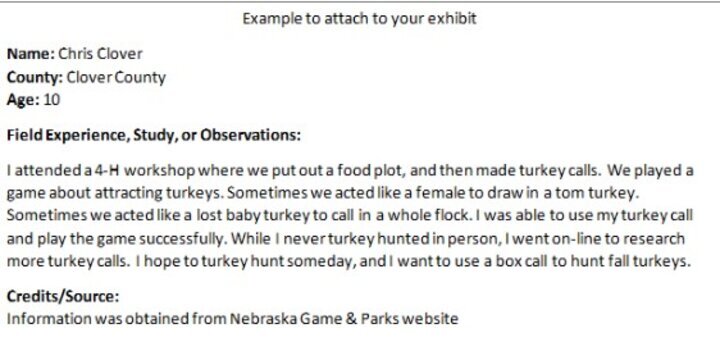
Data Tag

Family & Consumer Science

Clothing & Fashion Show Rules, Beyond the Needle, Crochet, Design Decision, Design My Place, General Clothing, Heirloom Treasures/Family Keepsakes, Home Design & Restoration, Human Development, Knitting, Quilt Quest, STEAM-Clothing 1, STEAM 2-Simply Sewing, STEAM 3-A Stitch Further & Visual Arts.
  • Enroll in 4-H (Due June 15th)
  • Nuckolls County-Complete Pre-Entry Forms (Green Sheets) (Due by July 11th)
  • Thayer County-Complete Pre-Entry on FairWire (Due by July 19th@ 11:59pm)

County Fair

State Fair & Score Sheets

Additional Material

Information sheets for Classes 1 - 6 should include: 

  1. Where did I get the idea for this exhibit? 
  2. What decisions did I make to be sure exhibit is safe for child to use? 
  3. What age is this toy, game or activity appropriate for and why? (Infant, Birth-18 mths; Toddlers, 18 mths-3 yrs; Preschoolers, 3-5 yrs or Middle Childhood, 6-9 yrs.) 4-H’ers must give at least 2 examples that help in understanding the appropriateness of this exhibit for the age of the child (see project manuals). 
  4. How is the toy, game or activity intended to be used by the child?  

Information sheet for Class 8 should include: 

  1. State which ONE age group (infant, toddler, preschooler, middle childhood) the kit was prepared for. 
  2. What are children this age like? Give 2 examples to show how the kit would be appropriate for children this age. 
  3. What will the child learn or what skills will they gain by using the kit? 
  4. Which item(s) were made by the 4-H member. 4-H’er should make one or more items in the kit, but purchased items are also allowed. (It is highly suggested that an inventory list of items in the kit be included).  


Healthy Lifestyles & Safety

Cooking 101, 201, 301, & 401, Decorated Foods, Food Flop, Food Preservation, General Foods, Miscellaneous Foods, Safety, & Fire Safety. 
  • Enroll in 4-H (Due June 15th)
  • Nuckolls County-Complete Pre-Entry Forms (Green Sheets) (Due by July 11th)
  • Thayer County-Complete Pre-Entry on FairWire (Due by July 19th@ 11:59pm)

County Fair

State Fair & Score Sheets

Additional Material

Horticulture & Floriculture

Educational Exhibits, Floriculture, Fruits, Herbs, Houseplants, Special Garden Project, & Vegetables.
  • Enroll in 4-H (Due June 15th)
  • Nuckolls County-Complete Pre-Entry Forms (Green Sheets) (Due by July 11th)
  • Thayer County-Complete Pre-Entry on FairWire (Due by July 19th@ 11:59pm)

County Fair

State Fair & Score Sheets

Additional Material

  • Make sure plant variety Names are included with all exhibits!!

Miscellaneous

Miscellaneous
  • Enroll in 4-H (Due June 15th)
  • Nuckolls County-Complete Pre-Entry Forms (Green Sheets) (Due by July 11th)
  • Thayer County-Complete Pre-Entry on FairWire (Due by July 19th@ 11:59pm)

County Fair

Personal Development & Leadership

ESI: Entrepreneurship
  • Enroll in 4-H (Due June 15th)
  • Nuckolls County-Complete Pre-Entry Forms (Green Sheets) (Due by July 11th)
  • Thayer County-Complete Pre-Entry on FairWire (Due by July 19th@ 11:59pm)

County Fair

State Fair & Score Sheets

Science & Technology

Animal Science, Aerospace/Rockets, Computers, Electricity, Engineering, Entomology, Geospatial, Robotics, SET Energy, Vet Science, Welding, & Woodworking.
  • Enroll in 4-H (Due June 15th)
  • Nuckolls County-Complete Pre-Entry Forms (Green Sheets) (Due by July 11th)
  • Thayer County-Complete Pre-Entry on FairWire (Due by July 19th@ 11:59pm)

County Fair

State Fair & Score Sheets

Additional Material

  • Make sure all plans are drawn for all welding & woodworking projects
  • Agronomy
  • Citizenship
  • Clover Kids
  • Clothing
  • Conservation, Wildlife, & Shooting Sports
  • Consumer Management
  • Entomology
  • Entrepreneurship
  • Food & Nutrition
  • Forestry
  • Heritage
  • Home Design & Restoration
  • Horticulture
  • Human Development
  • Knitting & Crochet
  • Photography
  • Quilt Quest
  • Range
  • Disaster Response, Preparedness, & Safety
  • Science, Technology, Engineering & Math (STEM)
  • Vet Science
  • Visual Arts