Content
Conservation, Wildlife, & Shooting Sports
Including projects related to
Conservation, Wildlife, & Shooting Sports
- Enroll in 4‑H (Due June 15th)
- Nuckolls County-Complete Pre-Entry Forms (Green Sheets) (Due by July 13th)
- Thayer County-Complete Pre-Entry on FairWire (Due by July 19th@ 11:59pm)
Conservation, Wildlife, and Shooting Sports
General Rules
GENERAL RULES
Southern Plains Extension Unit County Fairs
ALL DEADLINES WILL BE ENFORCED.
The shows and events of the Nuckolls & Thayer County Fairs will be under the direction of the designated Extension staff and superintendents. The Extension staff and superintendents will make all on-the-spot decisions necessary for the operation of the shows. In case of a complaint or a disagreement with the show, the exhibitor should discuss it with the Extension staff and the superintendent within one hour after the show. If an agreement cannot be reached, then the exhibitor and/or the Extension staff and superintendent should request a grievance committee meeting. Grievance must be submitted in writing. The grievance committee will consist of two 4‑H Council members, two Fairboard members and one neutral superintendent. The decision reached by this committee is final.
Rules:
1. Eligibility Requirements- Competition in the county 4‑H Fair is open to youth who are enrolled in Nuckolls or Thayer County 4‑H projects in which he/she is exhibiting. The youth must be 8 years old on January 1 of the current calendar year and under the age of 19 years of age on January 1 of the current calendar year. CloverKid members are 5-7 years old on January 1 of the current calendar year.
2. Pre-Entry- Pre-entries are required for ALL fair exhibits.
PRE-ENTRY DEADLINES:
Nuckolls – Paper Entries Only – July 11th - 4:00 PM
Thayer – Online Entries Only- July 17th – Midnight
Absolutely NO late entries accepted!
*Subject to the 4‑H Council policy committee.
3. Number of Entries Allowed.
Nuckolls County ONLY- Unlimited entries per class numbermay be made per exhibitor with the exception of a limit of two entries per class in Horticulture.
Thayer County ONLY- Limit of two entries per class.
See General Animal Rules for livestock entries.
4. Entry Tags- Exhibits other than livestock contest must have entry tags attached to the exhibit at the time of entry. Tags are printed through your local Extension office.
5. Exhibits Released-See fair schedule. All fair exhibits are expected to be at the fair during scheduled times. Premium and support/booster payments will be forfeited for early removal of show animals with the exception of animals released for the animal’s welfare by written approval from a veterinarian or for legitimate reason with written approval from the species’ superintendent and a representative of the 4‑H council livestock committee. In case of emergencies, contact the office staff. The Extension staff is not responsible for items left at the fairgrounds after scheduled times.
6. Exhibit Space- Space will be assigned by the department superintendent(s). All possible care will be used to prevent loss or injury to articles or animals exhibited, but fair management will in no way be responsible should loss or injury occur.
7. Disclaimer of Responsibility- All persons participating in the Thayer or Nuckolls County Fairs, either as exhibitors or as spectators, agree to make no claim against said Thayer or Nuckolls County Fair Association/Board, its officers, employees, volunteers, or any other exhibitors for any loss or damage to persons or property in connection with the activities of the Thayer or Nuckolls County Fair and said participants agree to hold said Association and persons harmless from any such claims. Individuals will be held personally responsible for his or her actions and the Fair Association will not be accountable or responsible for any injury. Exhibitors are responsible for the health of their animals.
8. Ribbons & Premiums Awarded- All exhibits will be divided into groups according to merit.
Purple…………… Excellent Blue……………………...…Good
Red……………….Fair White………Needs Improvement Rainbow……..Non-Competition
Equal exhibits will be given ribbons of the same color in each class. Only worthy exhibits will be awarded ribbons and/or premium money. Trophies/banners/medals will only be awarded to purple & blue-ribbon exhibits. NO red or white ribbon entries will earn trophies. Unused trophies will be recycled. In case there are insufficient funds to pay premiums in full, they will be prorated and paid accordingly.
9. State Fair Eligibility-An exhibitor must be a 4‑H member enrolled in the county which she/he represents and must be 8 years old by January 1, with the exception of program specific age requirements for Shooting Sports and First Lego League.
10. State Fair Exhibits- The Extension staff deliver many exhibits to the State Fair as a courtesy to exhibitors. However, exhibitors may be asked to arrange transportation of some articles that are large or heavy.
11. State Fair Rules will apply when County Fair Rules are not adequate. In case the general rules conflict with department rules, the department rules govern.
12. Interview Judging- Clothing Judging- See interview information involving Clothing and Fashion included with the Clothing & Fashion show rules. Static Exhibit-Interview judging is encouraged but not required for all other static exhibits. 4‑Hers can interview once per project for a total of 5 interviews. Sign up for interview judging will occur at exhibit check in, in each of the project areas. Interviews will be scheduled according to the project and class. If the 4‑Her can’t make a certain time, we will try to work with them, but we cannot guarantee that they will get to interview with all the projects they want.
13. Exhibits entered by 4‑H members with special needs will be marked for the judge’s information only. Families will provide this information.
14. Identification- In addition to entry tag, a label with the exhibitor’s name, item’s department, division, and class should be attached to each separate piece of the exhibit.
15. Scoresheets- Scoresheets used for classes in divisions are listed by the corresponding division or class. PLEASE NOTE: County Fair scoresheets are denoted with CF numbers whereas State Fair scoresheets are denoted with SF numbers. Many county classes will use state fair scoresheets. For example: Heritage scoresheets begin with letters SF therefore will be found on the scoresheet website listed above. If any entire division uses the same scoresheet, the scoresheet number will be listed under the division title.
16.* Classes- All classes with a star (*) after the class number are not eligible for state fair competition.
Rules
Conservation, Wildlife & Shooting Sports
Unlimited entries per class number may be made per exhibitor.
Scoresheets SF154 through SF163
Premium Code: STATIC ITEMS
Conservation, Wildlife and Shooting Sports gives 4-H members an opportunity to share their knowledge and field experience about conservation, wildlife, and shooting sports. When creating an exhibit, make sure to pay close attention to the rules while taking into account the different laws that surround those areas.
Rules:
1. NO FIREARMS, ITEMS WITH A BLADE (broadheads, knives, saws, etc.) or related items of any other kind, may be exhibited. This applies to actual items, replicated items and item parts. Photos are suitable substitution for actual items.
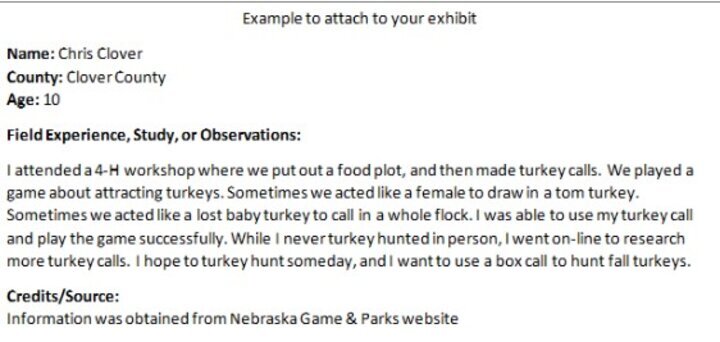
2. Show What You Did & Learned: All exhibitors must show evidence of their personal field experiences, study or observations that relate to their exhibit. This helps judges understand what the 4-H member did and learned in the process that led to the exhibit.
3. Proper Credit: Show proper credit by listing the sources of plans or other supporting information used in exhibits.
4. Whose Exhibit: Exhibitor's name, county, age must be on the back or bottom of all displays.
5. Wildlife & Wildlife Laws: “Animal" or "Wildlife" in the following classes includes wild fish, amphibians, reptiles, birds, or mammals. Domestic animals (i.e. domestic livestock or house pets) and insect exhibits are not appropriate for this area. 4-H members must comply with current state and federal laws. It is illegal to possess threatened, endangered, or protected wildlife, or the feathers, nests, or eggs of non-game birds. These items cannot be part of an exhibit. Game birds and game animals taken legally during an open season may be used.
6. Project Materials- Related project booklets include Exploring Your Environment Series, 4-H Shooting Sports, Amphibians, Bird Behavior (EC 59381), Fishing for Adventure Project Manuals, Wildlife Conservation (4-H 125), Geology, and Outdoor Adventure. Other resources include Outdoor Skills: Learning Science in the Outdoors series (Science Signature Outcome Program), outdoornebraska.gov/afterschool/ and www.whep.org
7. Exhibit Size Guidelines:
a. Board & Poster Exhibits- Mount all board exhibits on 1/4” plywood, Masonite, or similar panel no larger than 24” high by 24” wide. Poster exhibits should be on regular poster sheets, no larger than standard size (22” by 28”) but half size, 22” by 14”, is recommended.
b. All Other Exhibits: Exhibits other than poster/display board should not exceed 48” X 48” and be able to be moved by two people. Large exhibits (larger than listed above) must be suited and prepared for outdoor exhibition at the Nebraska State Fair. If large exhibits are not suitable for outdoor exhibition, youth have the option to create a poster or another suitable substitute for the exhibit, instead of exhibiting the project itself.
Harvesting Equipment
HARVESTING EQUIPMENT
Premium Code: STATIC ITEMS
Dept D Division 343
Classes
1 Fish Harvesting Equipment- Scoresheet SF168A- Board exhibit. Display of equipment used in fish harvesting. Examples: fishing knots, hooks (with corks over ends for safety), lures. Label all items displayed. Include in your exhibit the following information: a) the purpose of each item, b) when or where each item is used, c) any personal experiences you've had with the item(s).
2 Build a Fishing Rod- Scoresheet SF169A- Rod building kits with instructions are available for this purpose. A fishing rod educational exhibit may not exceed 96” in length. Exhibit must be mounted on a board. Include with exhibit: Explanation of cost of materials/components, where materials/components were purchased, how many hours required for construction. Label all parts. Necessary components which must be included are grip, line guides (based on manufacturers specifications), guide wraps, and hook keeper. Reel seats need to be aligned with guides, and guides aligned accurately down rod. Guide wraps of size A to D, nylon, or silk thread. Exhibit will be judged on workmanship, labeling of parts, information, and neatness.
3 Casting Target- Scoresheet SF170A- Make a casting target for exhibit and use. Target must be under 48” x 48”. The bullseyes must be 2 feet. The outer band must be 1 foot in diameter and can have up to 3 rings. They must be easy to store, durable, and weather resistant. Include the purpose and rules of using your casting target.
4 Wildlife Harvesting Equipment- Scoresheet SF168A-Board Exhibit. Display of equipment used in harvesting wildlife. Examples: expended ammunition casings (no live ammunition permitted), steel traps, hide stretchers, fleshers, etc. For displays of shotguns, rifles, or bows, use drawings or pictures. Label all items displayed the purpose of each item, when or where it is used, and any personal experiences had with the item(s).
5 Inventing Wildlife/Fish Harvesting Equipment, Aid or Accessory- Scoresheet SF168A- Use engineering principles to invent or adapt equipment that helps you harvest fish or wildlife. This could include wildlife calls, adapted fishing pole for shallow water, a blind, decoys, etc. Share your drawing (or adapted plans), how the equipment works, how you tested it, and the results of testing your prototype and any adjustments you made.
Other Natural Resources
OTHER NATURAL RESOURCES
Premium Code: STATIC ITEMS
Dept D Division 361
Classes
1 Design Your Own Exhibit in Natural Resources, Conservation, Geology or Ecology- Scoresheet SF164- This class is for educational exhibits relating to natural resources, conservation, geology, or ecology ONLY! Entries must be appropriate for fair display and no larger than 24” x 24”. All entries must include a title and should be clear (use a brief explanation or other method) about the intended purpose or message- what the exhibit is meant to show. Think about accuracy, creativity, educational value for viewers, and evidence of the 4-H member’s personal experiences and learning.
Outdoor Adventures
OUTDOOR ADVENTURES
Premium Code: STATIC ITEMS
Rules: See Conservation/Wildlife General Rules for more information.
Outdoor Adventures Level 1
Dept D Division 341
Classes
20* POSTER-Scoresheet SF281-Create a poster or display no larger than 22” X 28”. Topics may include one of the following but not limited to: trail map(s) you have hiked, hiking essentials, your hiking adventures, wildlife, or plants observed while hiking (birds, animal prints, butterflies, etc.), plan a hike, explain “Leave No Trace” and how this was followed during hiking, collection of photos from your hikes.
21* JOURNAL/BINDER-Written report of actual, virtual or imagined trail(s) hiked with observations, OR field journal (notes of actual experiences, sights, sounds, smells, etc.), OR camping trip diary. Feathers/leaf/flower pressings must be securely attached if included. Photos or drawings of observations encouraged. Exhibits measure no larger than 16” X 16”.
22* HIKING SAFETY-Must include explanation of use of item, why selected/purpose of item and how it meets hiking needs. May include, but are not limited to, one of the following: a compact hiking safety kit, homemade compass, or homemade water purifier. Exhibits measure no larger than 18” X 24”.
23* HIKING ADVENTURE GAME-Create a game of trails of outdoor adventures. Must be educational on one or more aspects of hiking, must include clear instructions as to the purpose and what can be learned by playing the game. Exhibits measure no larger than 18” X 24”.
24* OTHER HIKING ITEMS-Must include what inspired the creation of the item and its purpose. May include but are not limited to one of the following: hiking backpack, nature art, nature poem or story, homemade hiking snack mix displayed in a re-sealable plastic bag. (Include why ingredients were selected and nutritional value). Exhibits measure no larger than 18” X 24”.
Outdoor Adventures Level 2- Scoresheet SF281
Dept D Division 341
Classes
1 Poster -Topics may include, but not limited to one or more of the following; how to pitch a tent, knot tying, cooking over a campfire, how to start a campfire, wildlife and plants identified while camping, how to set up emergency shelter, dealing with weather, collection of photos from camping trips, “Leave No Trace” and how that was followed while camping, plan a camping trip, camping essentials, environmental issues/protecting natural resources, park or trail clean up, sanitation/hygiene while outdoors or use of GPS.
2 Journal/Binder- Written report of virtual or actual camping/hiking trips with observations OR field journal (notes of actual experiences, sights, sounds, smells, etc.), OR camping or hiking trip diary. Explain growth in project, leading the hikes, planning the camping trip, now being able to identify the wildlife and nature around you and how identified (sight/sound/shape/smell/color). Feathers/leaf/flower pressings must be securely attached, if included. Photos of drawing of observations encouraged. Exhibits measure no larger than 16” X 16”.
3 Camping/Hiking Safety- Must include explanation of use of item and why selected/purpose, how it fits hiking/camping needs. May include, but are not limited to, one of the following: travel sized poisonous plants guide, camping first aid kit, weather/water safety or hand hygiene kit.
4 Digital Media- Use digital media to show video/slideshow/presentation of setting up a tent (include why site is chosen) or protecting natural resources or environmental issues or computer video camping/hiking game. Submit a USB drive or DVD inside a report cover or notebook. If using a slideshow, include printed slides inside report cover or notebook.
5 Other Camping Items - Must include what inspired the creation of the item, and its purpose. May include but are not limited to one of the following: nature art, nature haiku poem, spider web sketches or knot display.
Outdoor Adventures Level 3- Scoresheet SF281
Dept D Division 341
Classes
6 Poster - Topics may include but not limited to one of the following: Topographic map, backpacking trip plan, camp layout, plan an expedition (can be dreamed or lived), collection of photos from your expedition, trails hiked, cost comparison of rental vs purchase or using GPS/compass.
7 Journal/Binder - Written report of actual, virtual, or imagined expeditions/camping/hiking, OR field journal (notes of actual experiences, sights, sounds, smells, etc.). Explain growth in project, challenges in leading a group, teaching others about wildlife and nature identification and “Leave No Trace.” Exhibits measure no larger than 16” X 16”.
8 Expedition Safety - Must include an explanation of use of items, why selected/purpose of item, how it meets hiking/camping/expedition needs. May include but are not limited to; travel sized edible plants, creepy crawly guide, tent repair kit, travel first aid kit or weather/water safety.
9 Digital Media - Use digital media to show video/slideshow/presentation of one of the following but not limited to; building a non-tent shelter (include why needed), packing your backpack/equipment and getting it onto you, teaching others about environmental issues or a computer video backpacking expedition game. Submit a USB drive or DVD inside a report cover or notebook. If using a slideshow, include printed slides inside a report cover or notebook.
10 Other Expedition Items - Must include what inspired the creation of the item, and the purpose of the item. May include but are not limited to; nature art, nature cinquain poem, backpacking food recipes, hiking/expedition conditioning plan, charcoal etching, dehydrated meal or snack (at least 1 cup displayed in a re-sealable plastic bag with ingredients, instructions, and nutritional facts included). Exhibits measure no larger than 18” X 24”.
Shooting Sports
SHOOTING SPORTS
Premium Code: STATIC ITEMS
4-H Shooting Sports requires 4-H members to be under the direct leadership of a certified 4-H Shooting Sports Leader in either shotgun, rifle (bb gun), archery, pistol, black powder/muzzleloader, and/or hunting skills. No firearms can be entered as an exhibit, nor live ammunition: however, information can be shared through pictures. Classes 4-9 can be entered by anyone in the Conservation and Wildlife area. Remember to look at the General Rules for this area.
Dept D Division 347
Classes
1 Shooting Aid or Accessory – Scoresheet SF253A- Any item which helps the shooter/hunter better perform their sport, examples: rifle sling, kneeling roll, arm guard, shotgun vest, target boxes, shooting stick, etc. Include your design, or plans you adapted, what the item is and used for.
2 Storage Case – Scoresheet SF254A- Any item with the purpose to safely hold a firearm, bow, ammunition, and/or arrows. Examples: soft sided shotgun case, quivers, firearm safe. Include your design, or plans you adapted. Explain how the storage case is used.
3 Practice Game or Activity – Scoresheet SF255A- Invent or adapt an activity to practice or teach a project skill. Include pictures of youth playing the game, testimonials for 4-H members who played the game, what skill is being worked on, and directions for the game. Explain how you came up with the game or adapted it to fit the needs of your group members.
4 Science, Engineering, Technology Advancements of Shooting Sports, Conservation. Or Wildlife Essay or Display – Scoresheet SF256A- Choose a specific area of shooting sports and share how it has advanced. Include a timeline and photos or illustrations. Keep your topic narrow and manageable. Essays are limited to 1000 words and should be on 8 ½ x 11” paper.
5 Healthy Lifestyles Plan – Scoresheet SF257A- Include a shooter’s (hiker’s, camper’s, angler’s) diet and exercise plan, and how the 4-H member will benefit or improve from following the plan. Ideally, the 4-H member would follow the plan and include some journal entries about adaptations or improvements made while following the plan.
6 Citizenship/Leadership Project – Scoresheet SF258A- Share a display on a citizenship project or leadership project the 4-H member took on individually or with a group to improve some aspect related to 4-H Shooting Sports, Conservation or Wildlife. Examples could be range development, conservation planting to attract wildlife, a camp, or 4-H recruitment event. Include who benefitted from the project, what the 4-H member’s role was, and any results.
7 Career Development/College Essay, Interview or Display – Scoresheet SF252A- Research opportunities for careers related to this area or opportunities for college majors or college activities to help discover using project skills beyond a person’s 4-H career. Essays are limited to 1000 words and should be on 8 ½ x 11 paper. Interviews need to include a picture of the interviewee in their work setting, questions asked, and a transcript of answers.
8 Community Vitality Display – Scoresheet SF251A- Explore the difference shooting sports, conservation, fishing, and hunting make in keeping Nebraska vibrant especially in rural areas. Present facts and research in an interesting way for the public to learn from.
9 Ag Literacy-Value Added Agriculture Interview or Research Project – Scoresheet SF250A- Explore how traditional ag producers are adding value to their production agriculture operations through conservation efforts, hunting, raising pheasants, shooting sports related tourism, etc. Present findings in an interesting way for the public to learn from.
10 Shooting Sports Educational Exhibit or Display- Scoresheet SF25A- Create an educational exhibit or display relating to a topic about Shooting Spors. Displays involving firearms or bows may be exhibited as a photographic display on a poser or in a notebook. Handmade items must include information explaining how the item was made and its intended use. Photos are encouraged.
Taxidermy
TAXIDERMY
Scoresheet SF172
Premium Code: STATIC ITEMS
Dept D Division 346
Class
- Tanned Hides- Any legal fish, bird, or other wild animal properly processed by the member. No requirement as to mounting but must meet the size requirement listed under General Rules. Must include the following: information about the 4-H member's personal field experiences, study, OR observations that relate to the exhibit.
- Taxidermy- Any legal fish, bird or other wild animal properly processed by the member. No requirement as to mounting but must meet the size requirement listed under General Rules. Must include the animal’s name and the following: information about the 4-H member’s personal field experiences, study OR observations that relate to the exhibit.
Wildlife and How They Live
WILDLIFE AND HOW THEY LIVE
Classes 1-4 are board or poster exhibits. Display may show any aspect of wildlife, wildlife habitat, or related conservation. No domestic livestock, pets or insects allowed. For more ideas, refer to project booklets.
Dept D Division 340
Classes
1 Mammal Display- Scoresheet SF157A- Choose one mammal from the wild and share on your display about the mammal. Examples include life history, behavior, habitat or other interesting facts.
2 Bird Display- Scoresheet SF157A- Choose one bird from the wild and share your display about the bird. Examples include life history, behavior, habitat or other interesting facts.
3 Fish Display- Scoresheet SF157A- Choose one fish from the wild and share on your display about the fish. Examples include life history, behavior, habitat or other interesting facts.
4 Reptile or Amphibian Display- Scoresheet SF157A- Choose one reptile or amphibian and share on your display about the reptile or amphibian. Examples include life history, behavior, habitat or other interesting facts.
5 Wildlife Connections- Scoresheet SF157A- Board or poster exhibit. The purpose of this display is to show interconnections and related aspects among animals, plants, and other habitat components. All displays should show two or more interactions (connections) that occur between/among animals or between animals and their habitat. Displays might show how animals interact with other animals, with people, or with their habitat. Examples:
- Food chain display. Use pictures, drawings, or other items to illustrate the source of food energy and where it goes- who eats whom or what. Use arrows to show the direction of the energy (food) flow.
- Show the role of predators, scavengers, insect eaters, or others in nature.
- Show how wildlife numbers (populations) change throughout the year.
- Show predation, competition, or other behavioral interactions of wildlife.
- Choose one kind of wildlife and make observations through a season or year, keep notes of interactions, then make a display of what you saw.
6 Wildlife Tracks- Scoresheet SF158A- Board or diorama-type box exhibit. Make a display of animal tracks using casting plaster. There are 3 options. For all options, include a brief description of your experiences in making the tracks so the judge better understands what you did and learned. Positive casts (impressions as they would be in nature) are preferred.
Options:
- Should show plaster tracks of five or more kinds of wildlife along with a picture or illustration of each kind of animal.
- Should show two or more plaster tracks of one specific kind of wildlife and should include a picture or illustration of the animal, what the animal may eat, and what may eat the animal.
- Should show two tracks and include the animal’s habitat needs including preferred food, shelter, water, and space in addition to picture of illustration of the animal.
7 Wildlife Knowledge Check- Scoresheet SF157A- Use electrical circuits, pictures, or other methods of teaching wildlife identification or other wildlife conservation or shooting sports related knowledge. Plan size and shape to fit transportation and display; maximum size 24” x 24.”
8 Wildlife Diorama– Scoresheet SF160A- Exhibit must be no larger than 24” x 24.” The exhibit might show a grassland, prairie, agricultural, woodland, riparian (stream or river corridor), wetland, and/or other area with wildlife habitat. Example: show an area interspersed with several habitats such as windbreaks, farm fields, woods, waste areas, ditches, and pastures for edge-adapted species such as White-tailed deer, Northern Bobwhite, Mourning Doves, Cottontail Rabbits, Fox, Squirrels, Northern Cardinals, or Bluejays. Label the habitats displayed and show at least five kinds of wildlife in their proper habitats. Remember to include supporting information about the wildlife and habitat that is on display.
9 Wildlife Essay- Scoresheet SF161A- Learn how to share educational information by writing. Choose a conservation or wildlife topic that interests you and write an essay about it. For example, write about a particular species of wildlife that you have observed or about the values of wildlife. You might write about wildlife on farms, in town, in a backyard, at a backyard feeder, or at other places. You might write about ethics, proper behavior in the outdoors, hunting or fishing. The essay is between 100 and 1000 words long and be typed, double spaced on 8 ½ x 11 paper. You might use books, magazines, or personal interviews as resources, but you must give credit to all sources by listing them.
10 Wildlife Values Scrapbook- Scoresheet SF162A- Make a scrapbook about the value of wildlife. Value could include aesthetic, scientific, commercial, game, genetic, and/or ecological topics
11 Wildlife Arts- Scoresheet SF163A- The purpose of this class is to allow artistic exhibits that contain educational information about conservation and wildlife. Examples might include paintings, photographs, wood carvings, painted duck decoys, or songs or poems written by the 4-H member. Entries must be appropriate for fair display and no larger than 24" x 24". For example, paintings or photographs should be displayed in notebook format or mounted on a sturdy display panel. All entries must include a title and brief explanation of the purpose or message (what is the exhibit meant to show).
Wildlife Habitat
WILDLIFE HABITAT
Premium Code: STATIC ITEMS
Dept D Division 342
Classes
1 Houses- Scoresheet SF165A- Make a house for wildlife. Examples: bird house (bluebird, purple martin, wood duck, kestrel, barn owl, etc.) or bat house; no insect houses. Make the house functional so that the dimensions, hole size etc. are appropriate to fit the intended species' needs. Include the following information: 1) the kinds of animal(s) for which the house is intended, 2) where and how the house should be located for best use, 3) any seasonal maintenance needed, and 4) any evidence of your personal observation or experiences. Tips: check NebGuide on bird houses and shelves.
2 Feeders/Waters- Scoresheet SF165A- Make a bird bath or feeder. Examples: seed, suet, or nectar feeders. Squirrel feeder okay; no insect feeders. Indicate the following information: 1) the kinds of animal(s) for which the water/feeder is intended, 2) where or how the water/feeder should be located for best use, 3) any seasonal maintenance needed, and 4) any evidence of your personal observations or experiences. Tips: check NebGuide on feeding birds.
3 Wildlife Habitat Design Board or Poster Exhibit- Scoresheet SF167A- Choose a backyard, acreage, or farm, and design a habitat plan to meet the food, water, shelter, and space needs of at least three kinds of animals you would like to attract. Draw an outline of the area and show what plants or another habitat will be provided. Indicate how the various parts of your plan provide the desired habitat needs. You might include an aerial photo of the area if you have one.
Nebraska State Fair and Other Resources
Nebraska State Fair Conservation, Wildlife, & Shooting Sports Fairbook
- Agronomy
- Citizenship
- Clover Kids
- Clothing
- Conservation, Wildlife, & Shooting Sports
- Consumer Management
- Entomology
- Entrepreneurship
- Food & Nutrition
- Forestry
- Heritage
- Home Design & Restoration
- Horticulture
- Human Development
- Knitting & Crochet
- Photography
- Quilt Quest
- Range
- Disaster Response, Preparedness, & Safety
- Science, Technology, Engineering & Math (STEM)
- Vet Science
- Visual Arts