This section of the Holt Boyd 4‑H Fair Regulation Book includes - Forestry and Conservation, Wildlife and Shooting Sports
County Only Exhibits:
IMPORTANT - There is NOT a County Only Section in the Fair book. There will either be a CF or SF in front of Class Number.
- CF: means that exhibit is ONLY eligible to be exhibited at the County Fair.
- SF: means that exhibit if CHOSEN at County Fair is eligible to advance to State Fair.
All exhibits eligible for entry at county and state fair are identified by numerical class numbers. Those which are eligible only for the county fair are identified by 900 numbers. Exhibit must be one that fits into the project area. Use manual for ideas. Call the Extension Office if you have questions.FORESTRY
This category provides 4-H'ers an opportunity to prepare displays that shows their expertise in many aspects of forestry. Involvement in this category will lead to expansion of seed, twig, wood, leaf, and tree knowledge for 4-H members. In addition, 4-H members will learn more about common Nebraska trees.
Rules
See the “General Rules and Regulations - Static Exhibits” section of this fair book for more information and additional resources.
- The official reference for all forestry projects is the Tree Identification Manual (4-H 332) which is available for purchase from UNL Marketplace. Other helpful forestry references include Trees of Nebraska (EC 92-1774-X), Leafing Out (4-H 431) and Plant a Tree (EC 17-11-80). Other reference materials are located in the Nebraska 4-H Share Point under Forestry. The official 2026 Nebraska 4-H Tree List will be found on the Share Point as well.
- Display "boards" must be made from wood or wood composite, e.g. plywood, fiberboard, or masonite, ¼" to ½" thick and no larger than 24" x 24" inches. Display boards may be coated, e.g., painted or varnished, on both sides to prevent warping.
- Display "posters" must be made from a material, e.g. foam board or poster board, that will stand upright without buckling and be no larger than 24" x 24".
- Display "books" must measure no more than 16" x 16".
- At least 5 of the 10 samples in Class 2, 3, 4, and 5 must be from the list of tree species found on the 2026 Nebraska 4-H Tree List. Samples must be from 10 different tree species. For example, Emerald Queen Maple and Crimson King Maple are both varieties of the same species (Norway Maple), and thus have the same genus and species name, i.e. Acer platanoides. All samples must be from trees, NO shrubs. If more than 10 samples are included in the display, only the first 10 samples from the current year will be judged.
- Due to the lifting of the quarantine restrictions in the state of Nebraska for all true ash species regarding the threat of Emerald Ash Borer, specimens such as Green Ash and White Ash will be accepted for all collections. Collections containing true ash species will NOT be disqualified from county or state judging.
- Remember that other general labeling standards apply. For example, scientific names are always italicized or underlined. Also, the first letter of a Genus name is always capitalized. The first letter of a species name is always lower case. When required, always indicate complete scientific names (Genus and species) and common names, (e.g. Norway Maple) even when “variety names” are included. For example, the scientific name of Emerald Queen Maple is Acer platanoides or Acer platanoides and the common name is Norway maple. “Emerald Queen” may be included as the variety name, but variety names are not required.
- How well the 4-H member follows written directions is an important factor in judging.
DIVISION 320 - FORESTRY CLASSES
SF-D320001 - Design Your Own Exhibit - Prepare an educational exhibit about an aspect of trees, forests, or forestry that is of special interest to you. Possible topics include paper recycling, grafting fruit or nut trees, proper pruning techniques, how wildlife are impacted by forests, history about a local arboretum, information about a historical tree in Nebraska, or the history of planting windbreaks in Nebraska, etc. The display must be no larger than 24" by 24" by 24". Original Photographs, drawings, samples, charts, posters, etc. can be used, but include enough information to adequately explain the topic that is being showcased. This exhibit will need to be substantially different from the other exhibit classes.
SF-D320002 - Leaf Display - The leaf display must include samples of “complete leaves” from at least 10 different tree species. At least 5 of the 10 samples must be from a tree on the 2026 Nebraska 4-H Tree List. The display must include at least two samples of simple leaves, compound leaves, and conifer leaves. Leaves should be pressed, dried, and mounted.
- Collection - Collect leaves any time after they have reached full size, usually beginning in early summer Leaf samples should be in good condition and representative of the average leaves on the tree. Keep in mind that shaded leaves are often much larger than leaves in full sun. Carefully remove leaves from the twig with the entire petiole or rachis intact. After collection, fresh leaf samples can be temporarily stored within the pages of an old magazine, but they should be properly pressed and dried for display. Be sure to record pertinent information during collection and when collecting leaves on private land, remember to get permission. All collection must be done by the 4-H member.
- Mounting - Leaves may be displayed in a notebook or on a display board. Any method may be used to mount leaves, - e.g., wire, glue, tape, staples but be sure all their features can be clearly identified.
- Labeling - The label for each sample must include: 1. common name 2. scientific name 3. leaf type (i.e. broadleaf, needle-like, etc.) 4. leaf arrangement (for broadleaf trees; i.e. alternate, opposite, whorled) 5. leaf composition (for broadleaf trees)i.e. simple, pinnately compound, palmately compound, etc.) 6. collector’s name 7. collection date 8. collection location (be specific, state and county at a minimum). If a twig is included with a sample, indicate “twig included” on the label. For example, the twig may be included with an Eastern Red Cedar sample because the leaves are very small and difficult to remove from the twig.
- Supplemental information: This may include general uses, common products, fall color, etc., to enhance its educational value. These are important factors in judging, and should not exceed 3 printed pages including citation of sources.
SF-D320003 - Twig Display - The twig display must include twig samples from at least 10 different tree species. At least 5 of the 10 species must be from the 2026 Nebraska 4-H Tree List. The display must include at least two samples each of opposite and alternate leaf arrangements from broadleaf trees.
- Collection - Twig samples should be collected during the dormant season (approximately November - March) when the buds are mature but before spring budbreak. Be sure to collect healthy twigs, not diseased or dead twigs. Twig samples must be at least 6 inches long and exhibit buds. The terminal end of the twig must be included. If present, leaves of deciduous trees should be removed. Leaves of evergreen trees should be retained but be sure the buds are visible. Side branches must be trimmed to less than 1 inch in length. All twig collection must be done by the 4-H member.
- Mounting - Twigs must be mounted on a display board. Any method including wire, glue, tape, staples, etc., may be used to mount twigs, but be sure all features can be clearly identified. The non-terminal end must be cut at a slant so the pith can be seen.
- Labeling - The label for each sample must include 1) common name; 2) scientific name; 3) leaf arrangement (for broadleaf trees i.e. alternate, opposite, whorled); 4) collector’s name; 5) collection date; 6) collection location (be specific, state and county at a minimum).
- Supplemental information: This may include general uses, common products, fall color, etc.to enhance educational value. These are important factors in judging, and should not exceed three printed pages including citation of sources.
SF-D320004 -Seed Display -The seed display must include seed samples from at least 10 different tree species. At least 5 of the 10 species must be from a tree on the 2026 Nebraska 4-H Tree List.
- Collection: Tree seeds should be collected at the time of year when they mature, which varies widely depending upon tree species. For example, Silver maple seeds mature in May while Norway maple seeds mature in September or October. Seed samples should be free of insect or disease symptoms. All seed collection must be done by the 4-H member. The focus of this display is seeds; however, species identification by seeds is often greatly aided by including the fruit, some seeds are very difficult to separate from the fruit. Use the following guidelines when preparing this display:
- If the fruit is displayed along with the seeds, clearly label each.
- Seeds enclosed in a dry, papery fruit (such as maple, ash, and elm) should be left within the fruit to aid in identification.
- Seeds enclosed in large fleshy fruit(s) (such as apple, mulberry, pawpaw) should be removed from the fruit and displayed without the fruit. Small fleshy fruits that can be dried (such as hackberry) may be displayed, but some seed should also be removed from the fruit and displayed alongside the dried fruit.
- Acorns (oaks) should be left intact to aid in identification.
- Seeds easily removed from the fruit, such as seeds within husk (walnuts, hickory, buckeye, etc.), a pod (honey locust, Kentucky coffee tree, etc.), or a capsule (poplar, sweetgum, etc.) should be removed from the fruit for display. The fruit may be displayed in addition to the seed.
- Cones from conifers (pines, spruces, fir, etc.) may be displayed along with the conifer seeds.
- Mounting: Seeds may be displayed in a variety of ways, e.g., mounted on a display board or displayed in jars in a rack, etc., but they must be securely mounted and easily viewed.
- Labeling: The label for each sample must include: 1) common name; 2) scientific name; 3) type of fruit (e.g. - samara, pod, nut, or legume, etc.); 4) collector’s name; 5) collection date; 6) date collected; 7) collection location (be specific, state and county at a minimum).
- Supplemental information: This may include general uses, common products, fall color, etc.to enhance educational value. These are important factors in judging and should not exceed three printed pages including citation of sources.
SF-D320005 - Wood Display - The wood display must include wood samples from at least 10 different tree species. At least 5 of the 10 species must be from a tree on the 2026 Nebraska 4-H Tree List.
- Preparation: Samples may be of any shape, for example sections from a board, wood cylinders, turned on a lathe, horizontal or vertical cross sections of a small log with bark attached. All samples should be the same shape, for example all wood cylinders or all sections of a board. Each sample can be no larger than 4 inches by 4 inches by 4 inches. Cut surfaces should be sanded to show the grain. Treating samples with a clear finish (no stain) is optional. All samples must be collected by the 4-H member.
- Mounting: Samples may be displayed in a variety of ways, for example mounted on a display board or displayed in a box or rack, etc. They must be securely mounted and easily viewed.
- Labeling: The label on each sample must include: 1) common name; 2) scientific name; 3) wood type (softwood or hardwood); 4) collector’s name; 5) collection date; 6) collection location (be specific, state and county at a minimum).
- Supplemental information: This may include general uses, common products, fall color, etc.to enhance educational value. These are important factors in judging, and should not exceed three printed pages including citation of sources.
SF-D320006 - Cross Section Display - a disc cut from a tree species listed on the 2026 Nebraska 4-H Tree List. The sample must be collected, by the 4-H member, within one year of the state fair judging day. The disc must measure 6 to 12 inches in diameter and 1 to 3 inches thick. The bark should be firmly attached, which may be difficult if the tree was dead when the disc was cut. Sand at least one side of the disc so the grain can be easily seen. If the disc is treated with a clear finish, both sides must be treated to minimize warping. As the disc dries, some cracking or checking can be expected and is allowed.
- Labeling: Label the following parts clearly, accurately, and securely attached Cross section should be labeled with pins, paper tags, or some other form of identification: 1. Pith 2. Heartwood 3. Sapwood 4. One growth ring (beginning and end) 5. Cambium 6. Bark. A separate label firmly attached to the back of the disc must include: 7. Common name 8. Scientific name Tree classification (softwood or hardwood) 10. Age (of the cross section) 11. Collector’s name 12. Collection date 13. Collection location (be specific, state and county at a minimum).
SF-D320007 - Parts of a Tree - (This exhibit is recommended for 4-H members ages 8–11) Prepare a poster, no larger than 24" x 24" that clearly identifies the main external parts of any tree: 1. Trunk 2. Crown 3. Roots 4. Leaves 5. Flowers 6. Fruit 7. Buds 8. Bark. Identifying other internal parts, e.g., phloem, xylem, cambium, annual ring, pith, etc., is optional. Attach a separate label on the back of the poster that includes the exhibitor’s name and age.
SF-D320008 - Living Tree Display- a living tree seedling grown by the 4-H member from seed in the display container. The seed must be from a species listed on the 2026 Nebraska 4-H Tree List. The seedling must be 60 days to 1 year old (on State Fair judging day). The display container must contain at least 8 inches of soil (potting mix or suitable natural soil) measured vertically, have a drainage hole(s), and a drain pan to catch drainage water. For this display, the 4-H member does not have to be the one to collect the seed, but they will need to plant the seed themselves.
- Labeling: A waterproof label must be attached to the pot or to a stake that is in the soil of the pot and include: 1. Common Name; 2. Scientific Name; 3. Seed Treatments (if any); 4. Planting Date 5. Emergence Date 6. Exhibitor’s Name.
- Supplemental information about the tree: Examples include where the seed was collected, growth measurements, uses for that species, etc. These may be included in an attached notebook, poster, etc. Supplemental information will enhance the educational value and be an important factor in judging. Supplemental information needs to be attached to either the pot or to a stake that is in the soil of the pot. DO NOT attach supplemental information to the living tree Supplemental information should not exceed 3 printed pages and cite sources of information.
SF-D320009 - Forest Product Display - Prepare a visual display and/or collection tracing the origin of one non-lumber product that comes from trees and/or forests. The display must be no larger than 24" by 24" by 24". Original photographs, drawings, samples, charts, posters, etc. can be used. Posters submitted may be no larger than 24" x 24" and may be either vertical or horizontal. The contestant must identify what species of tree the product is derived from and where the product is harvested, grown, or otherwise collected. The product listed must be partially or fully derived from trees, if partial the approximate percentage should be articulated in the display.
- The goal of this exhibit is for 4-H members to learn that many products come from trees and forests and to explore one of these products through in-depth study.
- Information about the tree or forest product: For example, information about harvesting, processing, industry information, and environmental or other benefits may be included to enhance educational value. Supplemental information will be an important factor in judging but should not exceed three printed pages of text. Cite sources of information.
- Personal interviews with industry professionals are encouraged as a source of information.
SF-D320010 - Forest Health Display - Prepare a visual display outlining a specific forest health issue such as a tree disease, insect pest, animal- or human-caused damage, or an abiotic issue such as weather damage. The display must be no larger than 24" by 24" by 24”. Original photographs, drawings, samples, charts, posters, etc. can be used. Actual specimens are strongly encouraged but must be properly preserved, i.e., insects pinned or placed in vials of alcohol, leaves pressed and dried. Posters submitted may be no larger than 24" x 24".
- Explain through the display what species of trees the health issue affects, diagnostic features of the issue (symptoms in trees, identifying features of the pest, etc.), and management options.
- Include common and scientific names of trees and pests.
- Supplemental information about the tree or forest health issue: for example, origin, proliferation in Nebraska/United States, and physiological effects on the tree may be included to enhance educational value. Supplemental information will be an important factor in judging but should not exceed three printed pages of text. Include citation of sources.
SF-D320011 - Wildfire Prevention Poster - Prepare a poster, no larger than 24" x 24" that promotes wildfire prevention strategies. Strategies articulated in the poster can include personal and/or land management actions such as forest management plans and implementation, placements of fire breaks or fuel breaks around buildings, wildfire preparedness items, etc.
- Supplemental information about wildfire prevention should be attached to the poster: for example, frequency of wildfires in Nebraska/United States, financial costs of wildfires, environmental factors that contribute to wildfires, etc. To enhance educational value. Supplemental information will be an important factor in judging but should not exceed 3 printed pages of text. Include citation of sources.
SF-D320012 - Tree Planting Project Display - Plant a tree in your community. Prepare a visual display where the 4-H member articulates proper tree planting techniques and follow up care for the tree after planting, why the individual tree species was chosen, as well as steps taken to continue care for the tree after initial planting. The display must be no larger than 24" by 24" by 24". Original photographs, drawings, charts, posters, etc. Can be used. Posters submitted may be no larger than 24" x 24". The tree must have been planted 60 days to 1 year before State Fair judging day. 4-H members must obtain permission from necessary authorities and property owners before planting any trees. Diggers Hotline (811) MUST be contacted before planting. Provide documentation that permission was obtained and that Diggers Hotline was contacted.
- Display: The following information about the tree must be included in the display: 1. common name 2. scientific name 3. planting location 4. planting date 5. tree source (nursery or store where the tree was purchased) 6. planter’s name is 7. proper tree planting steps 8. tree care and maintenance (after planting)
- Supplemental information about the tree: for example, why the species was chosen, growth measurements, uses for that species, etc., may be included in an attached notebook, poster, etc. to enhance educational value. Supplemental information will enhance educational value and be a factor in judging but should not exceed three printed pages of text. Include citation of sources.
CF-D320900 - Forestry - Other - Examples include Leaf Print display, Champion Tree Display, etc. Exhibit needs to relate to project area. You can add any additional information that you want the judge to know about your exhibit.
CONSERVATION, WILDLIFE, & SHOOTING SPORTS
Conservation, Wildlife and Shooting Sports gives 4-H members an opportunity to share their knowledge and field experience about conservation, wildlife, and shooting sports. All exhibits must follow all respective state and national laws relating to conservation.
Rules
See the “General Rules and Regulations - Static Exhibits” section of this fair book for more information and additional resources.
- NO FIREARMS, ITEMS WITH A BLADE (broad heads, knives, saws, etc.) or related items of any other kind may be exhibited. This applies to actual items, replicated items and item parts. Photos are a suitable substitution for actual items.
- Show What You Did & Learned: All exhibitors must show evidence of their personal field experiences, research or observations that relate to their exhibit. This helps judges understand what the 4-H'er did and learned in the process that led to the exhibit.
- Proper Credit: Show proper credit by listing the sources of plans or other supporting information used in exhibits.
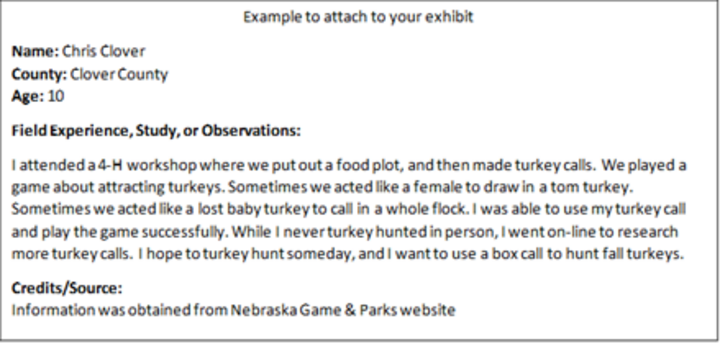
- Exhibitor Info: The exhibitor's name, county and age must be on the back or bottom of all displays.
- Wildlife & Wildlife Laws: "Animal" or "Wildlife" in the following classes includes wild fish, amphibians, reptiles, birds, or mammals. Domestic animal (i.e. domestic livestock or house pets) and insect exhibits are not appropriate for this area. 4-H members must comply with current state and federal laws. It is illegal to possess threatened,
- Project Materials: Related project booklets include Exploring Your Environment Series, 4-H Shooting Sports, Amphibians, Bird Behavior (EC 59381), Fishing for Adventure Project Manuals, Wildlife Conservation (4-H 125), Geology, and Outdoor Adventure. Other resources include Outdoor Skills: Learning Science in the Outdoors series.
- (Science Signature Outcome Program) Nebraska Game and Parks After-School Program and National Wildlife Habitat Education Program.
- Exhibit Size
- Board and Poster Exhibits: - Mount all board exhibits on ¼" plywood, Masonite, or similar panel no larger than 24" high by 24" wide. Poster exhibits should be on regular poster sheets, no larger than standard size (22" by 28") but half size, 22" by 14", is recommended.
- All Other exhibits: Exhibits other than poster/display board should not exceed 48" x 48" and be able to be moved by two people. Large exhibits (larger than listed above) must be suited and prepared for outdoor exhibition. If large exhibits are not suited for outdoor exhibition, youth have the option to create a poster or another suitable substitute for the exhibit, instead of exhibiting the project itself.
DIVISION 340 - CONSERVATION & WILDLIFE CLASSES
Wildlife and How They Live
Rules
Classes 1-4 are board or poster exhibits. Display may show any aspect of wildlife, wildlife habitat, or related conservation. No domestic livestock, pets, or insects allowed.
SF-D340001 - Mammal Display - (SF157A) - Choose one mammal from the wild and share on your display about the mammal. Examples include life history, behavior, habitat or other interesting facts.
SF-D340002 - Bird Display - (SF157A) - Choose one bird from the wild and share on your display about the bird. Examples include life history, behavior, habitat or other interesting facts.
SF-D340003 - Fish Display - (SF157A) - Choose one fish from the wild and share on your display about the fish. Examples include life history, behavior, habitat or other interesting facts.
SF-D340004 - Reptile or Amphibian Display - (SF157A) - Choose one reptile or amphibian and share on your display about the reptile or amphibian. Examples include life history, behavior, habitat or other interesting facts.
SF-D340005 - Wildlife Connections - (SF157A) - Board or poster exhibit - The purpose of this display is to show interconnections and related aspects among animals, plants, and other habitat components. All displays should show two or more interactions (connections) that occur between/among animals or between animals and their habitat. Displays might show how animals interact with other animals, with people, or with their habitat. Examples: Food chain display. Use pictures, drawings, or other items to illustrate the source of food energy and where it goes - who eats whom or what. Use arrows to show the direction of the energy (food) flow. Show the role of predators, scavengers, insect eaters, or others in nature. Show how wildlife numbers (populations) change through the year. Show predation, competition, or other behavioral interactions of wildlife. Choose one kind of wildlife and make observations through a season or year, keep notes of interactions, then make a display of what you saw.
SF-D340006 - Wildlife Tracks - (SF158A) - Board or diorama-type box exhibit. Make a display of animal tracks using casting plaster. There are 3 options. For all options, include a brief description of your experiences in making the tracks so the judge better understand what you did and learned. Positive casts (impressions as they would be in nature) are preferred.
- Option 1 should show plaster tracks of 5 or more kinds of wildlife along with a picture or illustration of each kind of animal.
- Option 2 should show 2 or more plaster tracks of one specific kind of wildlife and should include a picture or illustration of the animal, what the animal may eat, and what may eat the animal.
- Option 3 should show 2 tracks and include the animal’s habitat needs including preferred food, shelter, water, and space in addition to picture or illustration of the animal.
SF-D340007 - Wildlife Knowledge Check - (SF157A) - Use electrical circuits, pictures, or other methods of teaching wildlife identification or other wildlife conservation or shooting sports related knowledge. Plan size and shape to fit transportation and display; maximum size 24" x 24".
SF-D340008 - Wildlife Diorama - (SF160A) - Exhibit must be no larger than 24" x 24". The exhibit might show a grassland, prairie, agricultural, woodland, riparian (stream or river corridor), wetland, and/or other area with wildlife habitat.
Example: show an area interspersed with several habitats such as windbreaks, farm fields, woods, waste areas, ditches, and pastures for edge-adapted species such as White-tailed deer, Northern Bobwhite, Mourning Doves, Cottontail Rabbits, fox, squirrels, Northern Cardinals, or Bluejays. Label the habitats displayed and show at least 5 kinds of wildlife in their proper habitats. Remember to include supporting information about wildlife and habitat that is on display.
SF-D340009 - Wildlife Essay - (SF161A) - Learn how to share educational information by writing. Choose a conservation or wildlife topic that interests you and write an essay about it. For example, write about a particular species of wildlife that you have observed or about the values of wildlife (commercial value, game value, genetic value, aesthetic value, ecological value, scientific value). You might write about wildlife on a farm, in town, in a backyard, at a backyard feeder, or at other places. You might write about ethics, proper behavior in the outdoors, hunting, or fishing. The essay is between 100 and 1000 words long and typed, double spaced, on 8 ½ x 11" paper. You might use books, magazines, or personal interviews as resources, but you must give credit to all sources by listing them.
D340010 - Wildlife Values Scrapbook - (SF162A) - Make a scrapbook value of wildlife. Value could include aesthetic, scientific, commercial, game, genetic, and/or ecological.
SF-D340011 - Wildlife Arts - (SF163A) - The purpose of this class is to allow artistic exhibits that contain educational information about conservation and wildlife. Examples might include paintings, photographs, wood carvings, painted duck decoys, or songs or poems written by the exhibitor. Entries must be appropriate for fair display and no larger than 24" x 24". For example, paintings or photographs should be displayed in notebook format or mounted on a sturdy display panel. All entries must include a title and brief explanation of the purpose or message (what is the exhibit meant to show).
CF-D340900 - Conservation and Wildlife - Other - Exhibit needs to relate to project area. You can add any additional information that you want the judge to know about your exhibit.
DIVISION 341 - OUTDOOR ADVENTURES
Rules
Refer to General Rules for more information.
DIVISION 341 - OUTDOOR ADVENTURES - LEVEL 2 CLASSES
SF-D341001 - Poster - (SF281) - Topics may include, but not limited to one or more of the following; how to pitch a tent, knot tying, cooking over a campfire, how to start a campfire, wildlife and plants identified while camping, how to set up emergency shelter, dealing with weather, collection of photos from camping trips, “Leave No Trace” and how that was followed while camping, plan a camping trip, camping essentials, environmental issues/protecting natural resources, park or trail clean up, sanitation/hygiene while outdoors or use of GPS.
SF-D341002 - Journal/Binder - (SF281) - Written report of virtual or actual camping/hiking trips with observations OR field journal (notes of actual experiences, sights, sounds, smells, etc.), OR camping or hiking trip diary. Explain growth in project, leading the hikes, planning the camping trip, now being able to identify the wildlife and nature around you and how identified (sight/sound/shape/smell/color). Feathers/leaf/flower pressings must be securely attached, if included. Photos of drawing of observations encouraged. Exhibits measure no larger than 16" X 16".
SF-D341003 - Camping/Hiking Safety - (SF281) - Must include explanation of use of item and why selected/purpose, how it fits hiking/camping needs. May include, but are not limited to, one of the following: travel sized poisonous plants guide, camping first aid kit, weather/water safety or hand hygiene kit.
SF-D341004 - Digital Media - (SF281) - Use digital media to show video/slideshow/presentation of setting up a tent (include why site is chosen) or protecting natural resources or environmental issues or computer video camping/hiking game. Submit a USB drive or DVD inside a report cover or notebook. If using a slideshow, include printed slides inside a report cover or notebook.
SF-D341005 - Other Camping Items - Must include what inspired the creation of the item, and its purpose. May include but are not limited to one of the following: nature art, nature haiku poem, spider web sketches or knot display.
DIVISION 341 - OUTDOOR ADVENTURES LEVEL 3 CLASSES
SF-D341006 - Poster - (SF281) - Topics may include but not limited to one of the following: Topographic map, backpacking trip plan, camp layout, plan an expedition (can be dreamed or lived), collection of photos from your expedition, trails hiked, cost comparison of rental vs purchase or using GPS/compass.
SF-D341007 - Journal/Binder - (SF281) - Written report of actual, virtual or imagined expeditions/camping/hiking, OR field journal (notes of actual experiences, sights, sounds, smells, etc.). Explain growth in project, challenges in leading a group, teaching others about wildlife and nature identification and “Leave No Trace.” Exhibits measure no larger than 16" X 16".
SF-D341008 - Expedition Safety - (SF281) - Must include an explanation of use of items, why selected/purpose of item, how it meets hiking/camping/expedition needs. May include but are not limited to; travel sized edible plants, creepy crawly guide, tent repair kit, travel first aid kit or weather/water safety.
SF-D341009 - Digital Media - (SF281) - Use digital media to show video/slideshow/presentation of one of the following, but not limited to; building a non-tent shelter (include why needed), packing your backpack/equipment, and getting it onto you, teaching others about environmental issues or a computer video backpacking expedition game. Submit a USB drive or DVD inside a report cover or notebook. If using a slideshow, include printed slides inside report cover or notebook.
SF-D341010 - Other Expedition Items - Must include what inspired the creation of the item, and the purpose of the item. May include, but are not limited to; nature art, nature cinquain poem, backpacking food recipes, hiking/expedition conditioning plan, charcoal etching, dehydrated meal, or snack (at least 1 cup displayed in a re-sealable plastic bag with ingredients, instructions, and nutritional facts included). Exhibits measure no larger than 18" X 24".
DIVISION 342 - WILDLIFE HABITAT CLASSES
SF-D342001 - Houses - (SF165A) - Make a house for wildlife. Examples: bird house (bluebird, purple martin, wood duck, kestrel, barn owl, etc.) or bat house; no insect houses. Make the house functional so that dimensions, hole size etc. are appropriate to fit the intended species' needs. Include the following information: 1) the kinds of animal(s) for which the house is intended, 2) where and how the house should be located for best use, 3) any seasonal maintenance needed, and 4) any evidence of your personal observations or experiences. Tips: check NebGuide on bird houses and shelves.
SF-D342002 - Feeders/Waterers - (SF165A) - Make a bird bath or bird feeder. Examples: seed, suet, or nectar feeders. Squirrel feeders acceptable; no insect feeders. Include the following information: 1) the kinds of animal(s) for which the water/feeder is intended, 2) where are how the water/feeder should be located for best use, 3) any seasonal maintenance needed, and 4) any evidence of your personal observations or experiences. Tips: check NebGuide on feeding birds.
SF-D342003 - Wildlife Habitat Design Board or Poster - (SF167A) - Choose a backyard, acreage, or farm, and design a habitat plan to meet the food, water, shelter, and space needs of at least three kinds of animals you would like to attract. Draw an outline of the area and show what plants or other habitat will be provided. Indicate how the various parts of your plan provide the desired habitat needs. You might include an aerial photo of the area if you have one.
CF-D342900 - Wildlife Habitat - Other - Exhibit needs to relate to project area. You can add any additional information that you want the judge to know about your exhibit.
DIVISION 343 - HARVESTING EQUIPMENT CLASSES
SF-D343001 - Fish Harvesting Equipment - (SF168A) - Board exhibit. Display of equipment used in fish harvesting. Examples: fishing knots, hooks (with corks over ends for safety), lures, etc. Label all items displayed. Include in your exhibit the following information: the purpose of each item, when or where each item is used, and any personal experiences you've had with the item(s).
SF-D343002 - Build a Fishing Rod - (SF169A) - Rod building kits with instructions are available for this purpose. A fishing rod educational exhibit may not exceed 96 inches length. Exhibit must be mounted on a board. Include with the exhibit: Explanation of cost of materials/components, where materials/components were purchased, and how many hours required for construction. Label all parts. Necessary components which must be included are grip, line guides (based on manufacturers specifications), guide wraps, and hook keeper. Reel seat needs to be aligned with guides, and guides aligned accurately down rod. Guide wraps of size A to D, nylon, or silk thread. Exhibit will be judged on workmanship, labeling of parts, information, and neatness.
SF-D343003 - Casting Target - (SF170A) - Make a casting target for exhibit and use. Target must be under 48" x 48". The bullseyes must be 2 feet; outer band must be 1 foot in diameter and can have up to 3 rings. The exhibit must be easy to store, durable, and weather resistant. Include the purpose and rules of using your casting target.
SF-D343004 - Wildlife Harvesting Equipment - (SF168A) - Board Exhibit. Display of equipment used in harvesting wildlife. Examples: expended ammunition casings (no live ammunition permitted), steel traps, hide stretchers, fleshers, etc. For displays of shotguns, rifles, or bows, use drawings or pictures. Label all items displayed: the purpose of each item, when or where it is used, and any personal experiences you've had with the item(s).
SF-D343005 - Inventing Wildlife/Fish Harvesting Equipment, Aid or Accessory - (SF168A) - Use engineering principles to invent or adapt equipment that helps you harvest fish or wildlife. This could include wildlife calls, adapted fishing pole for shallow water, a blind, decoys, etc. Share your drawing (or adapted plans), how the equipment works, how you tested it, and the results of testing your prototype and any adjustments you made.
CF-D343900 - Harvesting Equipment - Other - Exhibit needs to relate to project area. You can add any additional information that you want the judge to know about your exhibit.
DIVISION 346 - TAXIDERMY CLASSES
SF-D346001 - Tanned Hides - (SF172A) - Exhibit of a wild animal hide properly processed by the member. No requirement as to mounting but must meet the size requirement listed under General Rules. Must include the animal’s name and the following information about the exhibitor’s personal field experiences, study, OR observations that relate to the exhibit.
SF-D346002 - Taxidermy - (SF172A) - Any legal fish, bird, or other wild animal properly processed by the member. No requirement as to mounting but must meet the size requirement listed under General Rules. Must include the animal's name and the following: information about the exhibitor's personal field experiences, study, OR observations that relate to the exhibit.
CF-D346900 - Taxidermy - Other - Exhibit needs to relate to project area. You can add any additional information that you want the judge to know about your exhibit.
DIVISION 347 - SHOOTING SPORTS
Rules
4-H Shooting Sports requires 4-H members to be under the direct leadership of a certified 4-H Shooting Sports Leader in either shotgun, rifle (BB gun, air rifle, .22), archery, pistol, black powder/muzzleloader, and/or hunting skills. NO firearms can be entered as an exhibit; nor live ammunition; however, information can be shared through pictures.
DIVISION 347 - SHOOTING SPORTS EXHIBIT CLASSES
SF-D347001 - Shooting Aid or Accessory - (SF253) - Any item which helps the shooter/hunter better perform their sport, examples: rifle sling, kneeling roll, arm guard, shotgun vest, target boxes, shooting stick, etc. Include your design, or plans you adapted and what the item is and used for.
SF-D347002 - Storage Case - (SF254) - Any item with the purpose to safely hold a firearm, bow, ammunition, and/or arrows. Examples: soft sided shotgun case, quivers, firearm safe. Include your design, or plans you adapted. Explain how the storage case is used.
SF-D347003 - Practice Game or Activity - (SF255) - Invent or adapt an activity to practice or teach a project skill. Include pictures of youth playing the game, testimonials of 4-H members who played the game, what skill is being worked on, and directions for the game. Explain how you came up with the game or adapted it to fit the needs of your group members.
SF-D347004 - Science, Engineering, Technology Advancements of Shooting Sports, Conservation, or Wildlife Essay or Display - (SF256) - Choose a specific area of shooting sports and share how it has advanced, include a timeline and photos or illustrations. Keep your topic narrow and manageable. Essays are limited to 1000 words and should be on 8 ½ x 11" paper.
SF-D347005 - Healthy Lifestyles Plan - (SF257) - Include a shooter’s (hiker’s, camper’s, angler’s) diet and exercise plan, and how the 4-H member will benefit or improve from following the plan. Ideally, the 4-H member would follow the plan and include some journal entries about adaptations or improvements made while following the plan.
SF-D347006 - Citizenship/Leadership Project - (SF258) - Share a display on a citizenship project or leadership project the 4-H member took on individually or with a group to improve some aspect related to 4-H Shooting Sports, Conservation, or Wildlife. Examples could be range development, conservation planting to attract wildlife, a camp, 4-H recruitment event. Include who benefitted from the project, what the 4-H member’s role was, and any results.
SF-D347007 - Career Development/College Essay, Interview or Display - (SF252) - Research opportunities for careers related to this area or opportunities for college majors or college activities to help discover using project skills beyond a person’s 4-H career. Essays are limited to 1000 words and should be on 8 ½ x 11" paper. Interviews need to include a picture of the interviewee in their work setting, questions asked, and a transcript of answers.
SF-D347008 - Community Vitality Display - (SF251) - Explore the difference shooting sports and hunting makes in keeping Nebraska vibrant especially in rural areas. Present facts and research in an interesting way for the public to learn from.
SF-D347009 - Ag Literacy - Value Added Agriculture Interview or Research Project - (SF250) -Explore how traditional ag producers are adding value to their production agriculture operations through conservation efforts, hunting, raising pheasants, shooting sports related tourism, etc. Present finding in an interesting way for the public to learn from.
SF-D347010 - Shooting Sports Educational Exhibit or Display - (SF254A) - Create an educational exhibit or display relating to a topic about Shooting Sports. Displays involving firearms or bows may be exhibited as a photographic display on a poster or in a notebook. Handmade items must include information explaining how the item was made and its intended use. Photos are encouraged.
CF-D347900 - All Discipline Educational Display - Poster or display concerning a discipline (archery, bb gun/air rifle/rifle, pistol, shotgun, muzzleloading or wildlife) as part of the Shooting Sports project. Must be mounted on ¼" or ⅜" thick plywood, masonite, or similar panel, 24" x 24" (24" High x 22" Wide will be accepted). Display must be three-dimensional, NOT to exceed2" from face of poster. Sharp items (knives, broadheads, etc..) must be enclosed in Plexiglas and secured. The judge must be able to open them to examine the items. A 5" x 8" note card must be attached securely describing: 1) The project and how it applies to Shooting Sports; 2) Experience gained in making the project; and 3) How the project will be used. Information should be neatly hand-written or typed on one side only of the card. Display may include safety, building or using equipment, or any aspect of the discipline of your choice.
DIVISION 361 - OTHER NATURAL RESOURCES CLASSES
SF-D361001 - Design Your Own Exhibit in Natural Resources, Conservation, Geology or Ecology - (SF164A) - This class is for educational exhibits relating to natural resources, conservation, geology or ecology ONLY. Entries must be appropriate for fair display and no larger than 24" x 24". All entries must include a title and should be clear (a brief explanation or other method) about the intended purpose or message – what the exhibit is meant to show. Think about accuracy, creativity, educational value for viewers, and evidence of 4-H memebers’ personal experiences and learning.
Printer Friendly Version with 2026 Changes in Green
- Resources for Environmental and Earth Science