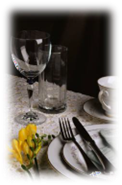
The Table Setting Contest is open to all Clover Kids and to any 4-H member enrolled in family and consumer sciences projects. This includes all foods, clothing, and home environment projects. Age divisions will be prior to Jan. 1 of current year - Clover Kid (5-7 years old); Junior (8-10 years old); Intermediate (11-13 years old) and Senior (14 and over).
The Table Setting Contest is a fun way to learn how to properly set a table; plan nutritious meals; express originality and creativity in choosing a theme; express knowledge of food, nutrition and food safety and present to a judge.
Entry Rules
Each exhibit must fit on a standard size card table and include the following:
- Clover Kids will place the theme tablecloth on the table with the decoration and the table setting (example: plate, napkin, fork, spoon, knife, glass) for the judge. The judge may ask very simple questions about MYPLATE.gov. No menu or food is required. A card with your name is also needed to turn over after judging.
- A theme
- A menu - either handwritten or printed on any size card. Be sure to check your spelling.
- One place setting for the menu featured. Use tableware (dishes, silverware, etc.) appropriate for the planned occasion. You DO NOT need to bring accessories such as salt and pepper shakers, sugars, creamers, etc. No live animals allowed on or by the table settings. No alcohol allowed on the menu or in the food. All decoration needs to be on the table. No decorations on the floor or walls. A centerpiece appropriate for the planned occasion. Table covering is appropriate for the occasion, if desired. Napkin folding is optional. Overall setting must show coordination of dishes, glassware, flatware, linens and centerpiece. Creativity must meet the basic table setting criteria;for example, follow proper flatware placement, etc.
- One food item from your menu along with the recipe either handwritten or printed on any size card. No kitchen facilities will be available, so try to include food that can be kept at room temperature or in a cooler without spoilage. Your food may be served on a plate or in the serving dish. BE CREATIVE! Remember the judge may taste the food.
- Your name on a card to turn over after your table has been judged. Tables remain up until the conclusion of the Style Revue for the public to view.
- Exhibitors will receive a schedule.
In Holt County - You may set up your display early but the display must be set up at least 10 minutes before your schedule judging time.
In Boyd County – You will be given a schedule with your set-up and interview time and the tables cannot be set up early. - Exhibitors must bring their own standard size folding card table. Do not bring a chair. Parents can only help carry in the items and unfold and set upright the table.
- Dress Code: 4-H members and Clover Kids must wear 4-H dress or dress appropriate for their theme.
- The judge will talk to each exhibitor as she/he judges their entry. The food, menu, table setting and individual are all important part of the judging. During judging, you PRESENT your table setting to the judge by telling about your ideas and why you chose this particular theme. Do not be afraid to explain why you did something. You should view yourself as a host and the judge as your guest. You should extend a welcome to your guest and present your ideas behind your theme, choice of menu, food preparation and food handling. You should also demonstrate an understanding of table setting techniques. You should be able to describe the ingredients and preparation required for all menu items, as well as food safety. Following your presentation, ask the judge if they have any questions. After your table has been judged, return to the exhibitor waiting area. Remember that the judge may be watching while you set your table and while you are waiting to interview with the judge so act accordingly.
- Irreplaceable items can be swapped with another item for the display at the fair.
Guidelines for Creating Your Table Setting
Do you know that you can be a designer each time you set the table? A designer chooses and arranges things according to a plan for beauty and order. A neat, interesting, clean and attractive table setting makes any meal more enjoyable.
Actually, there is more than one way to set a table. The usual way to set a table is to put all the dishes, flatware, and food on the table before anyone sits down. When there is company or for a special meal, part of the food and dishes may be left in the kitchen and served later. Diners at a buffet or a picnic may fill their plates and glasses before they are seated. The way to set your table depends upon the way the meal is served. Be creative and have fun! Color texture, design and creativity are important.
For the Table Setting Contest, one place setting is to be displayed. Include table covering, dinnerware, stemware, flatware, centerpiece and menu. Select and make one food from your menu. You MUST bring a standard size card table for the display.
Select a Theme - What is the occasion...a family dinner, a holiday, or lunch with friends? Is this a casual or formal occasion? Select a theme which fits the occasion. Possibilities can run from a casual fishing party sack lunch to a formal Mother’s Day dinner.
- Formal - use candles (lit only while being judged), more than three pieces of flatware, china (no stoneware), tablecloth and/or mats are acceptable and cloth napkins.
- Casual - be creative! Theme can be indoors or outdoors. Use any type of cover (tablecloth, paper, etc.) and any type of table service. Overall place setting should be an expression of your creativity; homemade touches are encouraged.
Table Appointments - These include any item used to set a table: tablecloth, placemats, dinnerware, glassware, flatware, and centerpiece. Choose table appointments to fit the occasion and carry out the theme. Paper plates, plasticware, and paper napkins may be used for a picnic but they would not be appropriate for a formal dinner. Flatware and dishware must be safe to eat from i.e., no glitter, glue, etc. is to be used on eating surfaces.
Table Covering - This is the background for the food and table appointments placed on it. It protects the table and makes for less noise. Placemats and/or tablecloths may be used. Sometimes the table is left bare. Choose a covering which is appropriate for the occasion and the other table appointments. You may match or blend colors and textures in the dishes - or use something quite different for contrast.
Place Setting - Allow at least 20 inches of space for each person’s dishes. This is called a cover and each cover is set exactly the same. A cover contains the dinnerware and flatware for the meal.
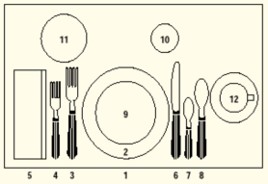
The following rules for setting a table correspond to the numbers seen in the table setting illustration shown here.
- The flatware, plate, and napkin should be one inch from the edge of the table.
- The plate is always in the center of the place setting.
- The dinner fork is placed at the left of the plate.
- If a salad fork is used, it is placed to the left of the dinner fork.
- The napkin is placed to the left of the fork, with the fold on the left (unless a decorative/creative fold is used). The napkin may also go under a fork or on top of the plate.
- The knife is placed to the right of the plate with the sharp blade facing in towards the plate.
- The teaspoon is placed to the right of the knife.
- If a soup spoon is needed, it is placed to the right of the teaspoon.
- The soup bowl may be placed on the dinner plate.
- The drinking glass is placed at the tip of the knife.
- If salad, bread and/or dessert plate(s) or bowl(s) - is used, place at the top of the fork(s).
- If coffee or tea is served, the cup is placed on the saucer and set to the right of the spoon. Have the handle pointing to the right.
Note: Only the utensils needed are placed on the table.
Centerpiece - The centerpiece should be coordinated with the table appointment and be appropriate for the occasion. Even though a single place setting is set, the centerpiece should be visible to all as if the entire table was set and should not obstruct anyone’s view of each other. Centerpiece can be purchased or arranged by the exhibitor. Centerpiece candles are only to be lit while being judged.
Tips and Reminders for Setting a Table
- The table should be clean; it can be left bare or a table covering can be used as the background for the food and the items may be placed on top of it. A table covering helps protect the table and muffles the noise of clanking glassware and dishes.
- Placemats or tablecloths can be used for special occasions.
- Dinnerware and flatware should be chosen as appropriate for the occasion and that complement each other. Matching or blended colors or textures in the dishes or contrast something different make a table setting look attractive.
- Table setting items should be appropriate for the meal served. Snacks on paper plates are appropriate while a home-cooked dinner should be served on attractive dishes to help show it off.
- Only the utensils needed are placed on the table.
- The centerpiece should be attractive. Simple ones, such as fresh flowers, a plant, or fruit can be used. If candles are used, they should be of the length so that if they were lit, they would be above eye level.
- The centerpiece should be low enough so that the people at the table can see over it; it should be colorful and blend with the tablecloth and the dishes; and be fresh and clean looking.
Menu Planning - An appropriately planned menu should follow the current USDA nutrition recommendations. As a general guideline, a meal should have at least three different food groups to help balance what the body needs every day to get all the nutrients needed.
When planning a menu, first decide on the main dish. Select appropriate vegetables, appetizer, soup or salad. Add a bread, dessert and beverage, if desired. Breakfast, party, and picnic menus should contain two or three food groups. Other meals should contain five food groups.
Participants are encouraged to develop interesting and creative menus. For example, you might name a food to fit your theme. Note: The use of alcoholic beverages in any menu will disqualify the table setting.
Common Errors in Menu Planning
Color
- Too many foods of same color
- No contrast or variation
- Clashing or unpleasant color scheme
Texture
- Too many soft foods
- Too many chewy foods
- Too many crispy or crunchy foods
- Lack of variety in texture
Size
- Too many mixtures
- Too many small pieces of the same size and shape
- Too many similar shapes
- Lack of variety in shape
Preparation and Type of Food
- No main dish
- More than one main dish
- Too many foods prepared in the same way, such as fried foods, creamed food, or foods with sauces
- Too many starchy foods
- Same fruit or vegetable more than once
- Too many high protein foods
Nutrition
- Too many foods from one food group
- Missing food groups
- Contain a variety of foods not meeting the nutritional needs of those for whom it is planned
Temperature
- Too many foods of the same temperature
- Not enough time allotted for preparation
- Need to keep hot foods hot and cold foods cold
- Food not stored at safe temperature (special consideration needed for picnics)
Flavor
- All bland flavor
- Too many strong flavors
- Repetition of food or flavor
- No tart or acid-flavor
- Too many sweet or too many sour foods
Writing the Menu
The menu should be displayed on any medium of choice (card, ceramic tile, chalkboard, etc.) printed or typed by the exhibitor. The menu may be decorated and/or propped up. The following guidelines are suggested when writing or planning a menu:
- Menus should be written in symmetrical arrangement on the page with the foods listed in the order they are served. (Every menu will not include all the foods listed here.)
Appetizer
Main Dish
Starchy Vegetable
Other Vegetables Salad
Bread
Dessert
Beverage
- Foods should be grouped by courses. Extra spacing should be allowed between courses.
- Descriptive terms should be used that give information about the temperature, texture, color, or other special characteristics of the food or method of preparation such as Chilled Apple Cider, Broiled Sirloin Steak, Cream of Asparagus Soup
- Words should be capitalized except articles and prepositions. Words such as or, and, of, with, etc. should not be capitalized.
- Foods served with an accompaniment should have the food listed first.
Baked Potato Sour Cream
OR
Cheddar Cheese Cubes
Rye Chips
- When the main dish has two or more accompaniments, the main dish should be centered on one line, and the accompaniments should be on the same line on either side or written on the line below.
Rye Crisp Chicken Soup Saltines
OR
Chicken Soup
Rye Crisp Saltines
- Butter, cream, sugar, or salad dressings are not written on the menu unless they are special in some way such as Whipped Butter or Thousand Island Dressing
- The beverage(s) should be listed last.
- The following is an example of how a three-course meal is properly written:
French Onion Soup Whole Wheat Wafers
Celery Sticks Assorted Olives
Prime Rib of Roast Beef au Jus
Potato Soufflé
Asparagus with Hollandaise Sauce
Mixed Green Salad
Hot Rolls Whipped Butter
Lemon Ice
Coffee Hot Tea
Dining Etiquette
Posture
- Place personal items (purse, hat, gloves) in a place other than on the table.
- Sit up straight with arms and elbows off the table.
- All four legs of your chair should rest on the floor.
- Don’t fidget or squirm.
- Ask for items to be passed rather than reach across the table.
- Hats and caps are to be removed upon entering a building.
Table Service
- Hold flatware between thumb and forefinger.
- Avoid gesturing with your flatware.
- Use the flatware from the outside first.
- After using a fork, knife or spoon, place it on the plate. Never lay a used utensil on the table.
- Service is from the left and dishes are passed to the right.
- Place the napkin in your lap. When leaving the table, place the napkin to the left of your plate.
While Eating
- Chew quietly with your mouth closed. Avoid slurping soup or noodles.
- Butter bread one bite at a time.
- Cut meat one bite at a time.
- Dip soup spoon into the bowl using a motion that moves the spoon away from you.
- Remove alien objects from your mouth with your fingers and place them on the side of your plate.
- Avoid talking with a full mouth. Take small bites.
- If the food is too hot, wait for it to cool rather than blowing on it.
- Take small portions at buffets. You may return for seconds.
- Keep table conversation pleasant and at a low volume.
- Discuss appropriate subjects at the table. Include all diners in the conversation.
Finishing the Meal
- When you have finished eating, leave your plate and other service items where they are. Place the fork and knife on the plate resting next to each other with the tines and blade toward the middle of the plate.
- Don’t pick your teeth at the table.
- Don’t fuss with hair or makeup at the table. Excuse yourself to the restroom for repairs.
Social Occasions
Being a Good Host - As the host, you are responsible for issuing invitations in a timely manner and having the event well organized so you can also enjoy the party. The host makes sure that all of the guests are greeted and introduced to the people they do not know. When you are hosting a social event, it’s your job to make sure that all of your guests are comfortable and are having a reasonably good time. The host is in charge of the conversation and makes sure that it stays at an acceptable level. Be sure that everyone is included in the conversation. Avoid crude and hurtful jokes as well as vulgar topics that may be offensive.
Being a Good Guest - When you receive an invitation, you must respond in a timely manner. Arrive within a few minutes of the designated time. Try not to arrive too early. Arriving “fashionably late” is not fashionable at all. If a meal is being served, it might be ruined by your tardiness. As a guest, it’s your responsibility to be respectful and pleasant. Make an effort to visit with everyone at the party.

RSVP - RSVP is the abbreviation for the French phrase repondez s’il vous plait which means please reply. If an invitation requests an RSVP, it is your responsibility to reply in a timely manner in the fashion the host indicates. This may be by returning an enclosed card, making a phone call or sending an email. A response is for the host’s convenience, not yours. This helps the host know how many people to plan for, especially if food will be served or if space is an issue.
Thank You Notes - Following the party, you should phone the host or write a short thank you note expressing your appreciation of the time you spent with them. It is appropriate to return the invitation within a month or so. Thank you notes should also be sent when you receive a gift even if you have given a verbal thank you at the time
Adapted 2026 by UNL Extension Holt Boyd Counties from the following resources: Scotts Bluff/Morrill Counties 4-H Table Setting Contest–Procedures & Guidelines, Lancaster County 4-H Table Setting Contest-Procedures & Guidelines, 4-H Foods Judging Guide, Adapted & Revised Edition, Amy Peterson, M.S., R.D. Extension Educator, UNL Extension-Polk County, 2012
The University of Nebraska does not discriminate based upon any protected status. Please see the Notice of Nondiscrimination.